
Home Blog Page 4

Coal India Recruitment 2026: 660 Management Trainee Vacancies Without Interview

0
Coal India

Coal India Releases New Government Job Notification

Coal India Limited (CIL) has released a new recruitment notification for Management Trainee posts. This is a great opportunity for engineering graduates and other eligible candidates who are looking for a Central Government job. Coal India is a Maharatna Public Sector Undertaking under the Ministry of Coal, Government of India.

A total of 660 vacancies have been announced for different disciplines. The best part of this recruitment is that there is no interview, no multiple exam stages, and no negative marking. Candidates only need to clear a single Computer-Based Test (CBT) to get selected.

The application process has already started, and interested candidates should apply before the last date.

Important Dates

EventDate
Notification Release DateReleased Today
Last Date to Apply11 June 2026
CBT Exam DateTo Be Announced
Admit Card ReleaseBefore Exam

Candidates are advised not to wait for the last date and complete the application process as early as possible.

Total Vacancies

Coal India has announced a total of 660 vacancies for Management Trainee posts in different departments.

Discipline-wise Vacancies

DisciplineVacancies
Civil Engineering178
Electrical Engineering221
Mechanical EngineeringMultiple Posts
SystemsMultiple Posts
Electronics & TelecommunicationMultiple Posts
GeologyMultiple Posts
Industrial Engineering11
Rajbhasha (Hindi)5
Company Secretary4
Total660

Educational Qualification

Candidates from different educational backgrounds can apply for these posts.

Engineering Disciplines

For Civil, Electrical, Mechanical, Electronics & Telecommunication, Industrial Engineering, and related branches, candidates must have:

  • BE/B.Tech/B.Sc Engineering degree in the relevant branch
  • Minimum 60% marks for General/OBC candidates
  • Minimum 55% marks for SC/ST/PwBD candidates

Geology

Candidates must have:

  • M.Sc or M.Tech in Geology, Applied Geology, Geophysics, or Applied Geophysics

Hindi

Candidates should have:

  • MA in Hindi from a recognized university

Company Secretary

Candidates must have:

  • Graduation in any discipline
  • Associate/Fellow Membership of ICSI

Relevant Branches Accepted

Coal India has clearly mentioned the acceptable branches for each discipline.

Civil Engineering

  • Civil Engineering
  • Courses where “Civil” or “Civil Engineering” is mentioned in the degree name

Electrical Engineering

  • Electrical Engineering
  • Electronics & Electrical Engineering

Mechanical Engineering

  • Mechanical Engineering
  • Mining Machinery Engineering

Electronics & Telecommunication

  • Electronics & Communication Engineering
  • Electronics & Instrumentation Engineering
  • Electronics & Instrumentation & Control Engineering

Final Year Students Can Also Apply

One of the biggest advantages of this recruitment is that final-year students are also eligible to apply. Candidates who are currently in the last semester of their course can submit the application form.

Selection Process

The selection process is very simple compared to many other government exams.

Selection Stages

  1. Single Computer-Based Test (CBT)
  2. Merit List Based on CBT Marks
Coal India

There will be:

  • No Interview
  • No Group Discussion
  • No Multiple Exam Stages
  • No Negative Marking

This makes the recruitment process easier for candidates.

Exam Pattern

The Computer-Based Test will be conducted for 3 hours.

Paper Structure

PaperSubjectsMarks
Paper 1General Awareness, Reasoning, Numerical Ability, English100
Paper 2Professional Knowledge100

Important Points

  • All questions will be Multiple Choice Questions (MCQs)
  • Each question carries 1 mark
  • No negative marking
  • Total Marks: 200

Paper 2 will contain questions related to the candidate’s professional subject or discipline.

Minimum Qualifying Marks

CategoryMinimum Marks in Each Paper
General/EWS40 Marks
OBC35 Marks
SC/ST/PwBD30 Marks

Candidates must secure the minimum qualifying marks separately in both papers.

Application Fee

CategoryFee
General/OBC/EWS₹1180
SC/ST/PwBD/CIL EmployeesNo Fee

The application fee can be paid online.

Age Limit

The maximum age limit is 30 years as on 30 April 2026.

Age Relaxation

CategoryRelaxation
OBC3 Years
SC/ST5 Years
PwBDAs Per Government Rules

Age relaxation benefits will be provided according to Central Government rules.

Salary and Benefits

Selected candidates will first join as Management Trainees. During the training period, the initial basic pay will be ₹60,000.

Salary Structure

Pay Scale₹60,000 – ₹1,80,000

After successful completion of one year of training, candidates will become officers in their respective disciplines.

Additional Benefits

Employees will also receive:

  • Dearness Allowance (DA)
  • House Rent Allowance (HRA)
  • Performance Related Pay (PRP)
  • Medical Facilities
  • Leave Benefits
  • Other Government Benefits

The total monthly salary can easily reach around ₹1.2 lakh depending on allowances and posting location.

Service Bond

Candidates will have to sign a service bond of ₹3 lakh.

However, candidates do not need to pay this amount separately. Around ₹5,000 will be deducted from salary every month. If the employee completes 60 months of service in Coal India, the deducted amount will be returned.

Posting Location

Selected candidates can be posted anywhere in India. However, candidates will be asked for their preferred locations during the posting process.

Why This Recruitment is Special

This recruitment is attracting a lot of attention because:

  • 660 vacancies are available
  • Only one CBT exam
  • No interview process
  • No negative marking
  • Good salary package
  • Government PSU job under Ministry of Coal
  • Final year students eligible

For candidates preparing for government jobs, this is one of the best opportunities of 2026.

Final Words

Coal India Management Trainee Recruitment 2026 is an excellent opportunity for graduates and engineering students. With high salary, simple selection process, and no interview, many candidates are expected to apply for these posts.

Interested candidates should check their eligibility carefully and complete the application form before 11 June 2026. Since there is enough time for preparation, candidates should start preparing for the Computer-Based Test as early as possible.
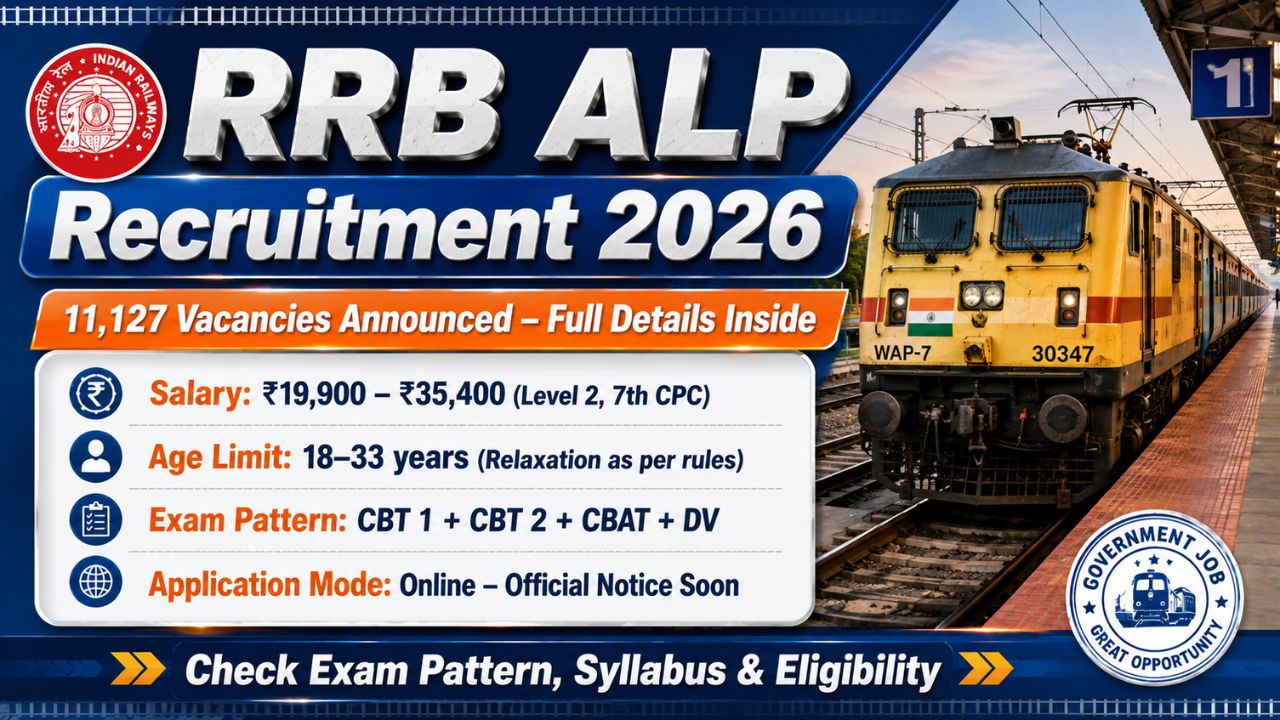
RRB ALP Recruitment 2026: 11,127 Vacancies Announced, Salary, Age Limit, Exam Pattern & Full Details

0
RRB ALP Recruitment

Railway ALP Notification 2026 Finally Released

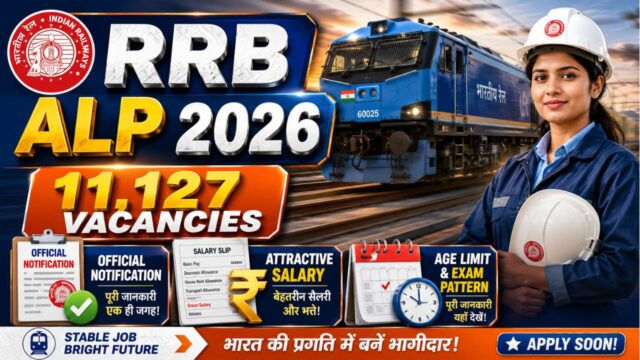
Hello everyone, welcome back with a new job recruitment update. The Railway Recruitment Board (RRB) has finally released the much-awaited RRB ALP Recruitment 2026 notification. Many students were waiting for this vacancy from a long time, and now the official notification is out with more than 11,000 vacancies.

This time, many important changes have also been made in the notification, especially for EWS category candidates and ex-servicemen. Along with that, the Railway Board has also increased the total number of seats compared to the previous recruitment.

In this article, we will discuss everything in simple language including vacancy details, salary, eligibility, medical standards, exam pattern, application fees, and selection process.

RRB ALP 2026 Vacancy Details

The recruitment is for the post of:

Post Name

Assistant Loco Pilot (ALP)

Total Vacancies

  • 11,127 Posts

Compared to the previous ALP recruitment, around 12% more seats have been added this time.

Pay Level

  • Level 2 under 7th Pay Commission

Job Type

  • Permanent Central Government Railway Job

RRB ALP Salary 2026

The basic salary for ALP posts is:

  • ₹19,900 per month

However, after including allowances like DA, HRA, and travel benefits, the starting in-hand salary becomes approximately:

  • ₹36,000 per month

Railway jobs also provide:

  • Medical facilities
  • Travel passes
  • Pension-related benefits
  • Job security
  • Promotion opportunities

Important Dates For RRB ALP 2026

Application Starting Date

  • 15 May 2026

Last Date To Apply

  • 14 June 2026 (11:59 PM)

Last Date For Fee Payment

  • 16 June 2026

Application Correction Window

  • 17 June to 26 June 2026

Candidates can make corrections in their application forms during this period.

Age Limit For RRB ALP Recruitment 2026

The age calculation will be done as on:

  • 1 July 2026

Minimum Age

  • 18 Years

Maximum Age

  • 30 Years

Category-Wise Age Relaxation

CategoryMaximum Age
General30 Years
OBC33 Years
SC/ST35 Years

Additional age relaxation is also available for:

  • Ex-servicemen
  • Railway staff
  • Widowed women
  • Divorced women
  • Judicially separated women

Educational Qualification For ALP 2026

There is no major change in qualification this time.

RRB ALP Recruitment

Required Qualification

Candidates must have:

  • Matriculation / SSLC
  • ITI from a recognized institution

OR

  • Apprenticeship training in relevant trade

OR

  • Diploma in engineering disciplines like Electrical, Electronics, Mechanical, Automobile, etc.

B.Tech Candidates Eligible

Candidates having engineering degrees such as B.Tech are also eligible for this recruitment.

Medical Standard For RRB ALP

One of the most important parts of ALP recruitment is the medical test.

Medical Category

  • A1 Medical Standard

Candidates must be physically fit in all respects.

Vision Requirements

Distant Vision

  • 6/6 without glasses

Near Vision

  • Must meet required standards without spectacles

Other Important Tests

Candidates must pass:

  • Color vision test
  • Night vision test
  • Binocular vision test
  • Fogging test

Candidates with serious color blindness may face difficulties in qualifying the medical stage.

RRB ALP Selection Process 2026

The selection process consists of multiple stages.

Stage 1 – CBT 1

This is the preliminary examination.

Exam Pattern

SubjectQuestions
Mathematics20
Reasoning25
General Science20
General Awareness10

Total

  • 75 Questions
  • 75 Marks
  • 60 Minutes

Negative Marking

  • 1/3 marks deducted for every wrong answer

Stage 2 – CBT 2

This is the main examination and has two parts.

Part A

This section is used for merit preparation.

Subjects Included

  • Mathematics
  • Reasoning
  • General Science
  • General Awareness

Marks from Part A are important for final selection.

Part B

This is qualifying in nature.

It is related to the candidate’s trade or technical qualification.

Minimum Qualifying Marks

  • 35%

Without qualifying Part B, candidates cannot move further in the recruitment process.

CBAT – Computer Based Aptitude Test

After CBT 2, shortlisted candidates will appear for:

  • CBAT (Computer Based Aptitude Test)

Railway has clarified that:

  • 50% weightage will come from CBT 2 Part A
  • 50% weightage will come from CBAT

Final merit will be prepared based on both scores combined.

Document Verification & Medical Test

After clearing all exams, candidates will go through:

  • Document Verification
  • Medical Examination

Final selection will happen only after successfully clearing these stages.

Application Fees For RRB ALP 2026

General & OBC Candidates

  • ₹500 Application Fee

Out of this:

  • ₹400 will be refunded after appearing in CBT 1

SC/ST/Female/Ex-Servicemen/Minority Candidates

  • ₹250 Application Fee

This full amount will be refunded after appearing in CBT 1.

This refund policy is helpful for many students preparing seriously for the exam.

Important Changes In EWS Rules

This time, Railway has added more detailed rules for EWS candidates.

For example, candidates may not qualify for EWS reservation if they have:

  • Agricultural land above the specified limit
  • Large residential property
  • Bigger residential plots

Students should carefully read all EWS conditions before applying.

Zone-Wise Vacancy Update

Different railway zones have different vacancy numbers.

According to the notification:

  • Mumbai region has the highest number of vacancies

Students should carefully choose their zone because cutoff marks differ from one zone to another.

Preparation Tips For RRB ALP 2026

Competition will be very high because of the large number of applicants and the popularity of railway jobs.

Focus On These Subjects

  • Mathematics
  • Reasoning
  • General Science
  • Current Affairs

Practice Regularly

  • Solve mock tests daily
  • Improve speed and accuracy
  • Practice previous year papers

Consistency and regular revision are very important for success.

Final Words

RRB ALP Recruitment 2026 is a great opportunity for students looking for a stable government job in Indian Railways. With more than 11,000 vacancies, decent salary, and permanent job benefits, this recruitment is attracting huge attention across the country.

Students should carefully read the notification, check eligibility, and start preparation seriously without wasting time. With proper planning and regular practice, clearing the ALP exam is definitely possible.

Do not hurry while filling the application form. Choose your railway zone carefully and prepare with full dedication.

Government Job Alert 2026: IIFCL AGM Vacancy with ₹78,000 Basic Pay & Massive Package 💥

0
Government Job

Introduction

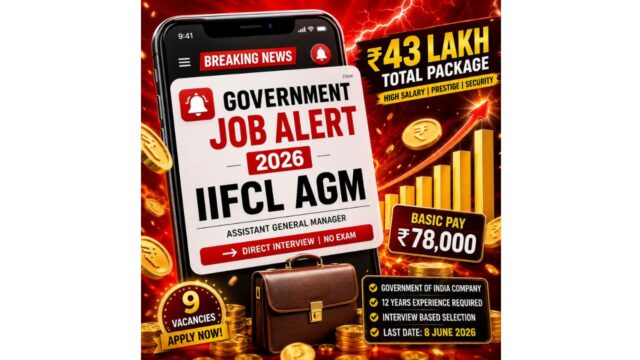
Hello friends, Recently a new recruitment notification for the post of Assistant General Manager (AGM) has released by the The India Infrastructure Finance Company Limited (IIFCL). This is a senior-level government job opportunity which is meant for highly experienced professionals from banking, finance, IT, and related sectors.

Unlike the other regular competitive exams, this recruitment is mainly based on the candidate’s experience, resume, and interview performance. Candidates with strong professional backgrounds and leadership experience can apply for this prestigious job position.

About IIFCL

IIFCL stands for India Infrastructure Finance Company Limited. It is a Government of India-owned company that provides financial support for infrastructure projects across the country.

The organization recruits candidates at different levels:

  • Grade A – Assistant Manager
  • Grade B – Manager
  • Grade C – Assistant General Manager (Current Recruitment)

The current notification is for Grade C posts, which are senior managerial positions.

Important Dates

EventDate
Application StartAlready Started
Last Date to Apply8 June 2026
Cut-off Date for Eligibility30 April 2026

Candidates must make sure that their age, qualifications, and experience are valid as of 30 April 2026.

Vacancy Details

The recruitment is being conducted on a regular basis for AGM (Grade C) posts.

Category-wise Vacancies

CategoryVacancies
Unreserved (UR)6
OBC2
EWS1
SC0
ST0
Total9

Some vacancies may increase or decrease depending on organizational requirements.

Salary and Benefits

The post offers an excellent salary package along with government job benefits.

Government Job

Salary Structure

ComponentDetails
Starting Basic Pay₹77,950 per month
Approximate CTC₹42.9 Lakhs per annum
House Rent Allowance15% of Basic Pay
Other BenefitsDA, Grade Allowance, Local Allowance, Special Allowance

The pay scale is also expected to be revised in the future, which means that salaries may further increases. Under this employment, Employees will additionally receive pension benefits under the National Pension System (NPS).

Probation and Posting

Selected candidates will be placed on the probation for one year. The company may extend the probation up to two years if required. Posting can be done anywhere in India or even abroad, depending on the company’s requirements.

Eligibility Criteria

Nationality:- Only Indian citizens are eligible to apply.

Age Limit

CriteriaDetails
Maximum Age45 Years
Cut-off Date30 April 2026

Note:- Candidates above 45 years of age on the cut-off date are not eligible.

Age Relaxation

CategoryRelaxation
SC/ST5 Years
OBC (NCL)3 Years
PwBD10 Years
PwBD + OBC13 Years
PwBD + SC/ST15 Years
Ex-Servicemen5 Years

Educational Qualification and Experience

The recruitment includes multiple specialized streams. Every stream requires a minimum of 12 years of experience.

Experience Requirement

RequirementDetails
Total ExperienceMinimum 12 Years
Relevant ExperienceMinimum 7 Years
Relevant SectorsBanking, Financial Institutions, PSUs, Reputed Corporates
Government Job

Stream-wise Vacancy Details

1. Risk Management (A1)

CriteriaDetails
Vacancies2
QualificationCA, CMA, MBA, B.E./B.Tech, PG in Mathematics, Statistics, Economics, Commerce, Business Administration
Preferred CertificationsFRM, CFA, PRM, Sustainability & Climate Risk

Candidates must have strong financial risk management experience.

2. Information Technology (A2)

CriteriaDetails
Vacancies2
QualificationB.E./B.Tech, MCA, M.Tech, M.Sc in CS, IT, Software Engineering, Electronics
Experience12 Years Total, 7 Years Relevant

This profile is suitable for senior IT professionals with banking or PSU experience.

3. Chief Information Security Officer – CISO (A3)

CriteriaDetails
Vacancies1
QualificationB.E./B.Tech, MCA, M.Tech, M.Sc in Computer Science/IT
ExperienceMinimum 12 Years

Candidates should have cybersecurity and information security experience.

4. Treasury, Hedging and Forex (A4)

CriteriaDetails
Vacancies1
QualificationCA, CMA, MBA
Additional RequirementCFA or FRM Certification Preferred

This role focuses on foreign exchange management and treasury operations.

5. Project Finance and Sustainability Finance (A5)

CriteriaDetails
Vacancies3
QualificationCA, CMA, MBA, B.E./B.Tech, PG in Finance, Management, Economics, Commerce
Experience12 Years with Financial Sector Exposure

This profile deals with infrastructure financing and sustainability projects.

Environment and Social Safeguard Profile

Candidates with qualifications in field like environmental sciences, social work, sociology, anthropology, climate science, or development studies may also apply under related streams.

Qualification Rules

IIFCL has clearly defined qualification requirements:

Course TypeMinimum Duration
Graduation3 Years
Post Graduation2 Years
Diploma2 Years

Only degrees from recognized universities approved by government regulatory bodies will be accepted.

Selection Process

The selection process is completely interview-based.

Stages of Selection

StageDescription
Application ScreeningBased on Resume and Experience
InterviewTechnical, Psychometric and Behavioral Assessment
Final Merit ListBased on Interview Marks

Minimum Qualifying Marks

CategoryMinimum Marks in Interview
General/OBC/EWS60%
SC/ST55%

Only candidates scoring these marks will be considered for the final merit list.

How to Apply

Candidates must apply through the official website of IIFCL.

IIFCL Official Website

Applications must be submitted before 8 June 2026.

Final Thoughts

This recruitment is an excellent opportunity for experienced professionals who is looking for a high-level government sector career. The salary package, benefits, and senior designation of this post makes it a prestigious position.

However, this recruitment is not suitable for freshers because every stream requires extensive professional experience. Candidates with strong banking, finance, IT, or infrastructure backgrounds should seriously consider applying.

UAE–Israel Secret Meeting Shock: Why Netanyahu’s Statement Created Tension in the Middle East

0
Israel

Introduction

A major political controversy has erupted in the Middle East after Israeli Prime Minister Benjamin Netanyahu publicly revealed that he had secretly visited the United Arab Emirates during the Iran conflict and met UAE President Mohamed bin Zayed Al Nahyan.

The timing of this revelation surprised the world because former U.S. President Donald Trump was reportedly involved in diplomatic discussions regarding tensions with Iran and regional peace efforts.

Soon after Netanyahu’s statement, the UAE officially denied that any such meeting had taken place. This contradiction created confusion and raised many questions about the hidden relationships and strategic alliances in the Middle East.

Netanyahu’s “Secret Visit” Statement

According to a statement shared from Netanyahu’s official office, he claimed that during military operations against Iran, he secretly visited the UAE and held discussions with President Sheikh Mohamed bin Zayed.

The statement described the visit as a “historic breakthrough” in relations between Israel and the UAE. However, many observers questioned why Netanyahu would publicly reveal a meeting that was supposedly secret.

Israel

Political analysts believe this announcement was not accidental. Instead, it may have been a strategic message directed toward Iran, the United States, and the Arab world.

UAE’s Immediate Denial

After Netanyahu’s statement became public, the UAE quickly denied that any official meeting had occurred.

This created an unusual diplomatic situation:

  • Israel claimed the meeting happened.
  • UAE officials denied it completely.

The UAE’s reaction suggests that the country is trying to avoid political backlash from the Muslim world. Many Gulf countries and Islamic organizations still strongly support Palestine and remain uncomfortable with close public relations with Israel.

The UAE is in a difficult position because it has developed strategic ties with Israel while also trying to maintain stable relations with neighboring Arab countries and Iran.

Why This Issue Matters

The controversy is important because it reveals how sensitive Middle Eastern politics has become after recent conflicts involving Iran and Israel.

Reports suggest that during the Iran-Israel conflict:

  • UAE faced heavy drone and missile threats.
  • Investors became nervous.
  • Tourism and financial markets were affected.
  • Oil and trade routes in the Gulf region came under pressure.

Some reports also claimed that Israel helped defend the UAE using advanced defense systems such as:

  • Iron Dome
  • Iron Beam

These are highly advanced Israeli air defense systems designed to intercept missiles and drones.

If these reports are true, it would mean Israel played a direct role in protecting the UAE during attacks connected to Iran.

The Growing UAE–Israel Relationship

Relations between the UAE and Israel were historically hostile because most Arab nations supported Palestine against Israel.

However, things started changing over the last decade.

Abraham Accords

In 2020, under the leadership of Donald Trump, the famous Abraham Accords were signed. These agreements normalized diplomatic relations between Israel and several Arab countries, including:

  • UAE
  • Bahrain
  • Morocco
  • Sudan

This was considered one of the biggest diplomatic shifts in modern Middle Eastern history.

After the agreement:

  • Israel and UAE opened embassies.
  • Trade increased rapidly.
  • Defense cooperation expanded.
  • Technology and intelligence sharing improved.

The relationship became especially strong in:

  • Cybersecurity
  • Artificial Intelligence
  • Agriculture
  • Defense technology
  • Investment partnerships

The Role of India and the I2U2 Group

A major economic partnership also emerged involving:

  • India
  • Israel
  • UAE
  • United States

This group became known as I2U2.

The alliance focused mainly on:

  • Trade
  • Infrastructure
  • Technology
  • Investment
  • Supply chains

India’s strong relationship with both UAE and Israel helped strengthen this cooperation.

The UAE viewed Israel as a technologically advanced partner that could help improve security and modernization efforts.

Why Iran Is Angry

Iran has long opposed Israel and considers countries supporting Israel as potential enemies.

Tensions between Iran and the UAE are also linked to geography and strategic control in the Persian Gulf.

Strait of Hormuz Dispute

The Strait of Hormuz is one of the world’s most important oil routes. Iran and UAE both have strategic interests in this region.

Israel

There are also disputes over islands such as:

  • Abu Musa
  • Greater Tunb
  • Lesser Tunb

The UAE claims these islands belong to it, while Iran controls them militarily.

Because of these tensions, Iran views growing UAE-Israel cooperation as a direct threat.

Reports of Secret Cooperation

Recent media reports suggested:

  • Israeli defense systems were deployed in the UAE.
  • UAE may have quietly supported operations against Iran.
  • Israeli intelligence and defense cooperation expanded secretly.

These reports increased suspicion in Iran.

Netanyahu’s public statement appears to have confirmed many of the rumors Iran already believed.

Iranian officials reportedly warned that they would not forgive countries helping Israel during attacks on Iran.

Why Netanyahu Revealed This Now

Experts believe Netanyahu had several possible reasons for revealing the secret relationship publicly.

1. Sending a Message to Iran

Netanyahu may have wanted Iran to understand that Israel is not isolated and has powerful regional partners.

2. Pressuring Diplomatic Talks

At the time of the announcement, diplomatic negotiations involving the U.S. and Iran were reportedly ongoing. Netanyahu may have wanted to remind everyone that Israel remains a key player in regional security matters.

3. Domestic Politics

Netanyahu also faces political pressure inside Israel. Strong national security messaging often strengthens his image among supporters.

UAE’s Biggest Fear

The UAE fears being isolated by the wider Muslim world.

Although the UAE normalized relations with Israel, many Arab populations still oppose Israel because of the Palestine issue.

If the UAE is openly seen helping Israel militarily:

  • Regional criticism may increase.
  • Iran could become more aggressive.
  • Gulf unity could weaken.
  • Economic stability could suffer.

That is why UAE officials are carefully trying to balance diplomacy with security partnerships.

Conclusion

The Netanyahu-UAE controversy highlights the complex and secretive nature of Middle Eastern geopolitics.

While countries publicly talk about diplomacy and peace, hidden military cooperation and strategic alliances continue behind the scenes.

The situation also shows:

  • The growing partnership between UAE and Israel.
  • Iran’s increasing suspicion of Gulf countries.
  • America’s influence in regional politics.
  • The importance of trade, energy, and security in the Gulf.

As tensions continue, the Middle East remains one of the most sensitive and strategically important regions in the world.

India’s Big Energy Plan: Can a Deep-Sea Gas Pipeline Protect the Economy?

0
Deep-Sea Gas Pipeline

Introduction

After winning the elections and forming a strong government, India is now focusing on another major challenge – the economy. The ongoing conflict in the Middle East has become a serious concern for India’s energy security and foreign exchange reserves. To address this problem, PM Modi has urged citizens to reduce unnecessary fuel use, avoid foreign trips, work from home if possible, and delay luxury spending such as gold purchases.

At the same time, the government of India is planning a massive new project worth around ₹40,000 crore which is going to be a deep-sea gas pipeline from Oman to India. If successful, this project could reduce India’s dependence on the Strait of Hormuz and improve long-term energy security.

Why India Is Worried About Energy Security

India imports nearly 90% of its oil and gas needs from foreign countries. Most of these supplies come through the Strait of Hormuz, a narrow sea route in the Middle East. Countries like UAE, Qatar, Saudi Arabia, and Iran use this route to send oil and gas to India.

The problem is that the current Middle East conflict has made this region unstable. Shipping risks have increased, insurance costs are rising, and there is always fear that supply routes may get blocked. If that happens, India could face shortages of LPG, crude oil, and natural gas.

This is why the Indian government is now trying to find safer and more stable alternatives.

The ₹40,000 Crore Deep-Sea Gas Pipeline Project

According to reports, India is considering building a deep-sea gas pipeline from Oman directly to the Indian coast, possibly Gujarat or Maharashtra. The project may take around 5 to 7 years to complete and is expected to cost nearly ₹40,000 crore. The Ministry of Petroleum has reportedly asked government-linked companies such as GAIL, Engineers India Limited, and IOCL to prepare a detailed feasibility report for the project.

 Deep-Sea Gas Pipeline

How Will the Pipeline Work?

Currently, most oil and gas shipments travel through the Strait of Hormuz. Under the new plan, a pipeline will be laid deep under the Arabian Sea, bypassing this risky route completely.

The pipeline would start from Oman and connect directly to India. Other Gulf countries such as Qatar, UAE, and even Saudi Arabia could send gas to Oman first, and then Oman could transfer it to India through this pipeline.

This would reduce India’s dependence on unstable sea routes and ensure uninterrupted gas supply even during geopolitical tensions.

One of the Deepest Sea Gas Pipelines in the World

Reports suggest that the pipeline could be laid nearly 3,500 meters below sea level. If completed, it may become one of the deepest undersea gas pipelines in the world.

Earlier, such projects were considered too expensive and technically difficult. But modern deep-sea pipeline technology has reduced construction costs significantly.

South Asian Gas Enterprise (SAGE), an Indian company, has already tested pipeline technology at depths of around 3,000 meters. This has increased confidence that the project is technically possible.

Why Gulf Countries Also Support This Idea

Countries like UAE and Qatar are also looking for new energy export opportunities. Many experts believe that Gulf nations now want to sell their oil and gas more aggressively before the world shifts heavily toward renewable energy.

At the same time, dependence on the Strait of Hormuz creates uncertainty for them as well.

Because of this, a direct deep-sea pipeline to India could benefit both sides:

  • India gets stable energy supplies.
  • Gulf countries get a secure and long-term export route.

This is one reason why Prime Minister Modi’s recent visit to UAE is being seen as strategically important.

India Had This Idea Earlier Too

Interestingly, this is not the first time India has discussed such a project.

Back in 2015, a proposal for a deep-sea gas pipeline was already suggested. The idea was to bypass Pakistan and avoid geopolitical risks connected with land-based pipelines such as:

  • TAPI Pipeline (Turkmenistan-Afghanistan-Pakistan-India)
  • IPI Pipeline (Iran-Pakistan-India)

However, despite discussions, the proposal did not move forward at that time.

Many experts now believe that India often reacts only after a crisis becomes serious instead of planning in advance.

Coal Gasification: Another Big Energy Move

Apart from the deep-sea pipeline, the Indian government has also approved a massive ₹37,500 crore coal gasification scheme.

In this process, coal is converted into synthetic gas, which can later be used like natural gas.

India has large coal reserves, so this technology could help reduce gas imports in the future.

However, critics point out that India announced coal gasification targets years ago, but progress has been very slow.

The Russia Factor

Russia has also assured India that energy cooperation between the two countries will continue despite global tensions.

In recent years, India reduced some Russian oil purchases under international pressure. As a result, India reportedly lost some discounted oil benefits that Russia had earlier provided.

Many analysts believe India should maintain strong energy partnerships with multiple countries to protect itself during global crises.

India’s Biggest Challenge: Energy Dependence

The biggest concern is that India still depends heavily on imported energy.

Even though renewable energy capacity is increasing rapidly, India still faces major storage problems. Solar energy is produced during the day, but without proper battery storage systems, much of it cannot be fully used at night.

This means India still relies heavily on fossil fuel imports.

Experts believe India needs a long-term national strategy to reduce energy import dependence step by step over the next 10–20 years.

Conclusion

The proposed Oman-India deep-sea gas pipeline could become one of India’s most important strategic energy projects. If implemented successfully, it may help India reduce risks from Middle East conflicts, stabilize gas supplies, and strengthen energy security.

At the same time, the project also shows how global wars and geopolitical tensions can directly affect ordinary people through rising fuel prices, inflation, and economic uncertainty.

India now faces a major challenge: balancing economic growth while reducing dependence on imported energy. Whether through deep-sea pipelines, renewable energy, or coal gasification, the country is clearly preparing for a future where energy security will become more important than ever.

Government Jobs 2026 Big Update 🚨 11,000+ Railway Jobs, RBI Officer, SSC & Bank Vacancies Out Now!

0
Government Jobs

These days, the demand for government jobs preparation has increased significantly, as unemployment is rising rapidly. Vacancies appear every year, but they are few and far between, while the number of students preparing is very high. You might say that if you get a government job today, you’ll have met God; it means your life will be secure and settled. If you are looking for a secure and high-paying government job then this is the right time to check the latest opportunities. Several new vacancies have recently been released by central government organizations for candidates ranging from 10th pass to graduates, diploma holders, engineers, and professionals.

In this article, we will discuss five important government job recruitments of 2026, including eligibility, age limit, salary details, selection process, and application deadlines.

1. SSC Stenographer Recruitment 2026

The first major opportunities coming up is the SSC Stenographer Grade C and Grade D Recruitment 2026. This recruitment is conducted by the Staff Selection Commission (SSC) for stenographer posts in different government departments.

Vacancy Details

  • Total Vacancies: 731+
  • Posts: Grade C and Grade D Stenographer
  • Qualification Required: 12th Pass
  • Application Start Date: 24 April 2026
  • Last Date to Apply: 15 May 2026

Age Limit

PostAge Limit
Grade C18 to 30 Years
Grade D18 to 27 Years

Application Fee

CategoryFee
General/OBC₹100
SC/ST/Female CandidatesFree

Selection Process

The selection process is simple:

  1. Computer-Based Test (CBT)
  2. Skill Test (Typing/Stenography)

There is no interview in this recruitment.

One major advantage is that the written exam does not include mathematics, making it easier for many students. Candidates only need good typing and stenography speed. Usually, a speed of around 70–80 words per minute is required.

This is one of the best opportunities for 12th-pass candidates looking for a central government job.

2. RBI Grade B Officer Recruitment 2026

The Reserve Bank of India (RBI) has also released the Grade B Officer Recruitment 2026 notification. RBI jobs are considered among the most prestigious government jobs in India because of its excellent salary, work environment, and career growth.

Vacancy Details

  • Total Vacancies: 60
  • Post: RBI Grade B Officer
  • Qualification: Graduation in any stream
  • Last Date to Apply: 20 May 2026

Age Limit

  • Minimum Age: 21 Years
  • Maximum Age: 30 Years

Selection Process

The recruitment process includes:

  1. Phase 1 Examination
  2. Phase 2 Examination
  3. Interview

Final selection is based on combined performance in all stages.

Who Should Apply?

This recruitment is especially beneficial for:

  • MBA Students
  • B.Com Graduates
  • Economics Students
  • Commerce Background Candidates

The salary package and allowances are very attractive, making it one of the best white-collar government jobs in India.

3. RRB Assistant Loco Pilot (ALP) Recruitment 2026

The Railway Recruitment Board (RRB) has announced Assistant Loco Pilot (ALP) vacancies for 2026. This is one of the largest recruitments this year.

Vacancy Details

  • Total Vacancies: 11,000+
  • Post: Assistant Loco Pilot (Train Driver)
  • Application Start Date: 15 May 2026
  • Last Date: 14 June 2026

Eligibility

Government Jobs

The following candidates can apply:

  • ITI Pass Candidates
  • Diploma Holders
  • Engineering Graduates

Age Limit

  • 18 to 30 Years

Application Fee

CategoryFee
General/OBC₹500
SC/ST/Female₹250

A large portion of the fee is refunded after appearing for the exam.

Selection Process

The process includes:

  1. CBT 1
  2. CBT 2
  3. Aptitude Test
  4. Medical Examination

There is no interview.

Benefits

  • Good salary
  • Railway allowances
  • Job security
  • Free and discounted travel benefits

This is a great opportunity for technical students who want a stable government career.

4. Coal India Limited Recruitment 2026

Coal India Limited, a major Public Sector Undertaking (PSU) under the Government of India, has released a new recruitment notification.

Vacancy Details

  • Total Vacancies: 660
  • Qualification Required:
    • B.Tech
    • MBA
    • CA
  • Application Start Date: 12 May 2026
  • Last Date: 11 June 2026

Selection Process

  1. Computer-Based Test (CBT)
  2. Document Verification

Why This Recruitment Is Important

Competition may be lower because only professional degree holders can apply. Ordinary graduates and 12th-pass candidates are not eligible.

Coal India jobs offer:

  • High salary packages
  • PSU benefits
  • Medical facilities
  • Housing and allowances
  • Strong career growth

Candidates interested in PSU jobs should definitely consider this recruitment.

5. Union Bank Apprentice Recruitment 2026

Union Bank of India has also announced Apprentice Recruitment 2026 for graduates.

Vacancy Details

  • Total Vacancies: 1865
  • Qualification: Any Graduate
  • Last Date: 19 May 2026

Age Limit

  • 20 to 28 Years

Benefits

Selected candidates will receive a monthly stipend during the apprenticeship period.

Selection Process

  1. Online Test
  2. Local Language Test

Final selection will depend on merit and state-wise performance.

This is a good opportunity for graduates who want banking sector experience and future career growth.


Quick Comparison Table

RecruitmentVacanciesQualificationAge LimitLast Date
SSC Stenographer731+12th Pass18–3015 May 2026
RBI Grade B60Graduate21–3020 May 2026
RRB ALP11,000+ITI/Diploma/Engineering18–3014 June 2026
Coal India660B.Tech/MBA/CAVaries11 June 2026
Union Bank Apprentice1865Graduate20–2819 May 2026

Final Thoughts

These five government job opportunities can be very important for students preparing for stable and well-paying careers. Whether you are a 12th-pass student, graduate, engineer, MBA, or professional candidate, there is something valuable for everyone.

Many students miss good opportunities simply because they do not get information on time. So, check the official notifications carefully and apply before the last dates.

Government jobs not only provide salary and security but also offer long-term career growth, allowances, and social respect. If you are serious about your future, this is the right time to take action and apply for the vacancies that match your qualifications.

Gold & Silver Prices About to Explode After Government’s Big Decision

0
Gold & Silver Prices

Introduction

Hello guys, ever since our Prime Minister Narendra Modi appealed to the citizens to reduce unnecessary fuel usage, avoid foreign trips, and postpone gold & silver prices purchases for at least one year, many people thought that the government might going to take some serious major economic decisions.

From now onwards, the government has officially increased the import duty on gold and silver from 6% to 15%. This sudden move by the government has created a lot of discussion and panic across the country. Many people are wondering why the government has taken such a strong step and what impact it will have on India’s economy, gold prices, and common citizens.

Let us understand this issue in simple language.

Government Increases Gold Import Duty

With an immediate effect, The Finance Ministry has increased the customs duty on gold, silver, and platinum.

New Import Duty Rates

  • Gold: from 6% to 15%
  • Silver: from 6% to 15%
  • Platinum: from 6.4% to 15.4%

The duty consists of:

  1. Basic Customs Duty (BCD)
  2. Agriculture Infrastructure and Development Cess (AIDC)

Earlier:

  • BCD on gold was 5%
  • AIDC was 1%

Now:

  • BCD has increased to 10%
  • AIDC has increased to 5%

This has pushed the total effective duty to 15%.

Why Has India Taken This Decision?

The main reason is the growing global economic uncertainty caused by tensions in West Asia, especially the Iran conflict.

Due to the ongoing war-like situation:

  • Crude oil prices have increased sharply
  • The Indian rupee is weakening
  • India’s current account deficit is rising
  • Pressure on foreign exchange reserves is increasing

India imports many essential items such as:

  • Crude oil
  • Gold
  • Electronics
  • Fertilizers

All these types of imports are being paid on the form of US dollar. When India spends more dollars on imports, the condition of rupee becomes weaker and inflation also increases. This situation is called external sector stress, and currently India is trying to protect itself from it.

Why Is Gold Considered a Problem During Crisis?

Gold is economically different from other imports.

Gold & Silver Prices

If India imports:

  • machinery,
  • technology,
  • or industrial equipment,

then those products help in manufacturing and economic growth.

But gold is mostly stored as jewelry or savings. Economists call it a non-productive import because it does not directly increase production or GDP growth.

For example:

  • A machine can produce goods and create jobs.
  • Gold mostly stays locked in lockers or homes.

So, every time India imports gold:

  • dollars go out of the country,
  • forex reserves decrease,
  • and the current account deficit increases.

During normal times, this may not be a huge issue. But during global economic tension, it becomes risky.

Iran Conflict and Oil Prices

The biggest trigger behind this economic pressure is the Iran-West Asia conflict.

Because of rising tensions:

  • Oil prices have crossed very high levels
  • Shipping routes are under threat
  • Marine insurance costs have increased

India has to imports a large amount of crude oil from the Persian Gulf region. So India is already spending extra dollars on oil imports. At the same time, if gold imports continue rises , India’s economic pressure increases further. This is why the government of India wants people to reduce gold purchases.

Weakening Rupee Is a Major Concern

The Indian rupee has weakened significantly against the US dollar.

The reasons include:

  • Rising import costs
  • High oil prices
  • Global uncertainty
  • Foreign investors taking money out of India

The government believes that increasing gold import duty will reduce gold imports. If fewer dollars are spent on importing gold, the rupee may get some support.

India’s Fear of Foreign Exchange Crisis

India has a painful economic memory from 1991.

At that time:

  • India’s foreign exchange reserves almost finished
  • The country had only a few weeks of dollar reserves left
  • India had to pledge its gold reserves internationally
  • Finally, the IMF had to provide a bailout package

Since then, Indian policymakers become very cautious whenever:

  • oil prices rise,
  • forex reserves come under pressure,
  • or the current account deficit increases.

The government does not want a similar crisis again.

India Imports Huge Amounts of Gold

India is the world’s second-largest buyer of gold.

In the financial year 2025-26:

  • India’s total import bill was around 775 billion dollars.

Out of this:

  • Crude oil,
  • Gold,
  • Vegetable oil,
  • and Fertilizers

together formed around 240 billion dollars.

Gold alone accounted for nearly 72 billion dollars. That means almost 10% of India’s imports were gold imports.

If India reduces gold imports by:

  • 30% to 40%, it can save around 20–25 billion dollars.
  • 50%, it can save nearly 36 billion dollars.

This could significantly reduce India’s current account deficit.

Why Didn’t the Government Ban Gold Imports?

Some people may ask why the government did not completely ban gold imports.

The reason is simple.

A complete ban could:

  • create panic in markets,
  • increase black marketing,
  • encourage illegal trade,
  • and damage investor confidence.

Instead, the government chose to increase import duty so that people buy less gold naturally.

Risk of Gold Smuggling

One major danger of higher import duty is smuggling.

When legal gold becomes expensive, illegal networks try to bring gold into India secretly from:

  • Dubai,
  • Nepal,
  • Bangladesh,
  • and Sri Lanka.

Smuggling increases:

  • black money,
  • hawala transactions,
  • and organized crime.

This is why customs officers and airport security agencies now have a bigger responsibility.

Impact on Common People

The new duty increase will affect ordinary citizens in several ways.

1. Gold Jewelry Will Become Expensive

Wedding jewelry, coins, and gold bars will become costlier.

Even if international gold prices remain stable, Indian prices will rise because of higher import taxes.

2. Pressure on Jewelry Industry

The jewelry sector may face difficulties because:

  • customer demand could decrease,
  • sales may slow down,
  • and employment may be affected.

Many jewelry associations are requesting the government to find balanced solutions.

3. Shift Towards Digital Gold

Investors may now prefer:

  • Gold ETFs,
  • Digital gold,
  • or paper gold investments

instead of physical gold.

4. Rural Families May Be Affected

In many rural areas, families use gold as a traditional form of savings. Higher prices may create financial pressure for them.

Conclusion

India’s decision to increase gold import duty is mainly aimed at protecting the economy during a time of global uncertainty caused by the Iran conflict and rising oil prices.

Gold & Silver Prices

The government wants to:

  • reduce unnecessary dollar outflow,
  • support the rupee,
  • control the current account deficit,
  • and avoid economic instability.

Although this move may create challenges for consumers and the jewelry industry, the government believes economic stability is more important during a crisis period.

The coming months will show whether this policy successfully protects India’s economy from global shocks.

Global Economic Shock May Be Coming Due to Iran War: Uday Kotak Warns India to Prepare

0
Economic

Rising Fear of an Economic Crisis:-

Around the world, the most famous economists and industrialists are repeating one serious warning — a major economic crisis may be approaching. According to leading Indian banker Uday Kotak, the full economic impact of the Iran war has not yet been felt by ordinary people, but the real shock is still coming.

Currently, many countries are still surviving by using their oil reserves. India is also using its strategic reserves to reduce the direct impact of Iran War rising international oil prices on common citizens. Because of this, people have not experienced the real pressure of this crisis till yet. However, according top the experts, this situation may not continue for long time.

Uday Kotak’s Big Warning:-

Recently, Uday Kotak said that the world must prepare for difficult economic times ahead. According to him, inflation will rise, fuel prices will increase, and daily life will become more expensive for everyone.

He explained that this is not about spreading fear or creating panic. Instead, it is about preparing early before the real economic shock arrives.

Kotak compared the situation to a coming storm. If people prepare in advance, the damage can be reduced. Waiting until the crisis fully hits could make the situation much worse.

He stated that many countries today have no strong foreign exchange reserves or oil reserves left. They are simply waiting helplessly for the economic shock to arrive. India, on the other hand, still has some time and options available.

Why Uday Kotak’s Opinion Matters:-

Many people may ask why Uday Kotak’s statements are taken so seriously.

Uday Kotak is one of India’s richest bankers and the founder of Kotak Mahindra Bank. His estimated net worth is around $14 billion. He has played an important role in India’s financial sector for decades.

He has also served on several major government and financial advisory committees, including those connected with infrastructure financing and securities markets. Because of his deep involvement in India’s economy and banking sector, his warnings are considered highly important.

Hidden Impact of the Iran War:-

Kotak explained that the world has not yet fully experienced the impact of the Middle East conflict on energy prices.

Global Economic Shock, Economic

India’s oil refining companies are already facing heavy losses because of rising crude oil prices. However, fuel prices inside India have remained mostly stable because oil companies and the government are absorbing the shock temporarily.

In many countries, petrol and diesel prices have already increased by 40–50%. India has managed to avoid such a large increase so far, which is one reason inflation remains relatively controlled.

But according to Kotak, this protection may not last forever.

He warned that consumers have not yet felt the true pressure of rising fuel costs. Once oil companies can no longer absorb the losses, fuel prices may rise sharply. This will directly affect transportation, food prices, and almost every product in the market.

The Middle Class May Suffer the Most:-

The biggest concern is for middle-class and lower-income families.

A person earning a limited income already struggles to manage expenses for food, education, healthcare, transportation, and family responsibilities. If fuel prices rise significantly, the cost of daily living will also rise.

Petrol and diesel are connected to almost every industry. When fuel becomes expensive, transportation costs increase. This eventually raises the prices of vegetables, groceries, medicines, clothing, and other basic commodities.

According to Kotak, people with fixed or limited salaries will face the greatest economic pressure during such a crisis.

Why India Is Asking Citizens to Save Money:-

The article also points out that Prime Minister Narendra Modi has repeatedly encouraged citizens to reduce unnecessary spending.

People are being advised to avoid expensive foreign trips, reduce luxury spending, and focus more on domestic tourism. The government has also encouraged work-from-home and digital learning in some areas.

These suggestions are not random. They are being seen as precautionary steps to conserve foreign exchange and prepare the country for a difficult global economic situation.

India still has some reserves and flexibility, but experts believe the country must act carefully before the global crisis becomes worse.

Global Impact Could Be Severe:-

The article also mentions warnings from JPMorgan Chase, one of the world’s largest investment banks.

According to reports, crude oil prices could rise dramatically if the conflict continues and oil supply routes remain affected. Inflation in countries like the United States could increase sharply, hurting middle-class consumers there as well.

If inflation rises in major economies such as the US and Europe, consumer demand may fall. This would damage global trade because many countries depend heavily on exports to Western markets.

The negative impact of the Iran war may therefore spread across the global economy, affecting businesses, jobs, and investments worldwide.

India’s Position in the Global Economy:-

Despite these concerns, the article suggests that India may still remain one of the world’s fastest-growing economies.

However, there is another major concern — the falling value of the Indian rupee. A weaker rupee increases the cost of imports, especially crude oil. This can create additional inflation inside the country.

India was once expected to rise rapidly in global GDP rankings, but the falling currency has slowed some of that progress.

Even so, experts believe India’s long-term growth story remains stronger than many other major economies.

Oil Supply Could Become a Bigger Problem:-

Another serious concern is the possible shortage of oil supplies if the conflict continues for many more months.

The article highlights fears surrounding the Strait of Hormuz, one of the world’s most important oil shipping routes. If supply chains are disrupted and oil reserves begin running low globally, panic buying and extreme price increases could occur.

Experts warn that by September, many countries may start facing serious oil reserve shortages if the war does not stop.

This could create a major supply-and-demand crisis in global energy markets.

Conclusion:-

The message from Uday Kotak is clear: the world may soon face a serious economic challenge because of the ongoing Iran conflict.

His warning is not meant to create fear, but to encourage preparation. Rising fuel prices, inflation, and global uncertainty could affect millions of people, especially middle-class families.

India still has time to prepare, but experts believe careful planning, controlled spending, and economic discipline will be necessary in the coming months.

If global tensions continue and oil supplies remain unstable, the economic shock could become much larger than what the world has experienced so far.

8th Pay Commission 2026: Expected Salary Hike for SSC, Railway & Other Government Exams

0
8th Pay
8th Pay

Big Update for Government Job Aspirants

Currently, the 8th Central Pay Commission (8th CPC) has become one of the most important discussion topics among students who are preparing for the government jobs. Salary is one of the main motivations behind preparing for exams like SSC, Railway, Banking, and other central government recruitments. Along with job security and designation, candidates always very interested and wants to know how much salary they will receive after selection.

According to recent discussions and reports, the 8th Pay Commission may be implemented from January 1, 2026, and the complete implementation process is expected to be finalized by the end of 2026 or the beginning of 2027. If this happens, government employees may receive a huge salary increase.

In this article, we will understand the expected salary structure under the 8th CPC, the role of the fitment factor, and how much salary increase SSC and Railway aspirants can expect.

What is the 8th Pay Commission?

The Central Pay Commission is a system used by the Government of India to revise salaries, pensions, and allowances of central government employees.

8th Pay

The previous 7th Pay Commission was implemented in 2016 with a fitment factor of 2.57. Now, discussions are going on regarding the 8th CPC, and many experts believe that the fitment factor may increase significantly.

The final salary hike will mainly depend on the fitment factor decided by the government.

What is the Fitment Factor?

The fitment factor is a multiplication number used to calculate the new basic salary from the old basic pay.

Formula:

New Basic Salary = Old Basic Salary × Fitment Factor

For example:

  • Current Basic Pay = ₹18,000
  • If Fitment Factor = 3

Then:

₹18,000 × 3 = ₹54,000

This means the new basic salary becomes ₹54,000.

Some discussions suggest the fitment factor may range between 3 to 3.83 under the 8th CPC.

Important Changes After 8th CPC

Whenever a new Pay Commission is implemented, some important changes happen:

  • Dearness Allowance (DA) becomes zero initially.
  • Basic pay is revised using the fitment factor.
  • HRA (House Rent Allowance) and TA (Transport Allowance) continue.
  • New DA calculation starts again from zero.

Currently, DA is around 58%, but after the implementation of the 8th CPC, it will reset to zero and gradually increase again over time.

Expected Salary Under 8th Pay Commission

The following salary calculations are based on an estimated fitment factor of 3.83.

Current Basic PayExpected New Basic Pay
₹18,000₹69,000
₹19,900₹76,000
₹21,700₹83,000
₹25,500₹97,000
₹29,200₹1,11,000
₹35,400₹1,35,000
₹44,900₹1,71,000
₹56,100₹2,15,000

These figures are estimated basic salaries only. After adding HRA, TA, and other allowances, the in-hand salary may become even higher.

Expected Salary for SSC Exams After 8th CPC

SSC MTS Salary

Currently, SSC MTS employees receive a basic pay of around ₹18,000.

After the 8th CPC:

  • Expected Basic Pay: ₹69,000
  • Estimated In-Hand Salary: ₹75,000–₹78,000

This is a massive increase compared to the current salary structure.

SSC CHSL Salary

SSC CHSL posts currently offer basic pay between ₹19,900 and ₹25,500.

After the 8th CPC:

  • Expected Salary Range: ₹76,000 to ₹97,000
  • Estimated In-Hand Salary: Around ₹85,000

This makes CHSL posts much more attractive for aspirants.

SSC Stenographer Salary

There are two grades in SSC Stenographer:

Grade D

  • Current Basic Pay: ₹25,500
  • Expected New Salary: ₹97,000

Grade C

  • Current Basic Pay: ₹35,400
  • Expected New Salary: ₹1.35 lakh

At present, Grade C employees already receive around ₹60,000–₹65,000 including allowances. After the 8th CPC, the salary may cross ₹1 lakh.

SSC CGL Salary

SSC CGL posts are among the most popular government jobs in India.

8th Pay

Under the 8th CPC:

  • Expected Salary Range: ₹1.7 lakh to ₹2.15 lakh
  • Estimated In-Hand Salary: Up to ₹1.9 lakh

Posts like AAO, ASO, and other higher-level positions may receive extremely attractive salary packages.

Railway and Other Government Jobs

The 8th pay CPC will not only benefit SSC employees but also Railway, Banking, and other central government staff.

Candidates preparing for:

  • RRB NTPC
  • Railway Group D
  • Banking Exams
  • Teaching Exams
  • Technical Government Jobs

may also see a major increase in salaries after implementation.

Will the Salary Really Increase This Much?

The actual salary increase depends entirely on the final fitment factor approved by the government.

If Fitment Factor is 3:

₹18,000 basic pay becomes ₹54,000.

If Fitment Factor is 3.83:

₹18,000 basic pay becomes ₹69,000.

Therefore, the final numbers may vary, but a significant salary increase is almost certain.

Why This is Good News for Aspirants

The expected salary hike is motivating many students to seriously prepare for government exams.

A higher salary means:

  • Better financial security
  • Improved lifestyle
  • More savings
  • Better pension benefits
  • Increased job attraction

This is why many coaching platforms and educators are encouraging aspirants to start preparation early instead of waiting for official notifications.

Importance of Starting Preparation Early

Many major SSC notifications such as:

  • SSC Selection Post
  • SSC Stenographer
  • SSC CGL

have already been released or are expected soon.

Experts suggest that students should focus on building strong fundamentals now because last-minute preparation often creates confusion and stress.

Aspirants are advised to regularly practice:

  • Mock Tests
  • Previous Year Questions
  • Current Affairs
  • Quantitative Aptitude
  • Reasoning
  • General Awareness

Consistent preparation is the key to selection.

Final Conclusion

The upcoming 8th Pay Commission is expected to bring one of the biggest salary hikes for central government employees. If the proposed fitment factor between 3 and 3.83 is approved, salaries for SSC, Railway, and other government jobs may increase dramatically.

Although the final announcement is still awaited, the possibility of higher salaries is already motivating lakhs of students across India to prepare seriously for upcoming government exams.

Candidates preparing for SSC, Railway, Banking, and other competitive exams should use this opportunity as motivation and continue their preparation with full dedication.

RRB JE CBT 1 Result 2025 Released: Cut Off Marks Out for Kolkata and Ranchi Zones

0
RRB JE CBT1 result

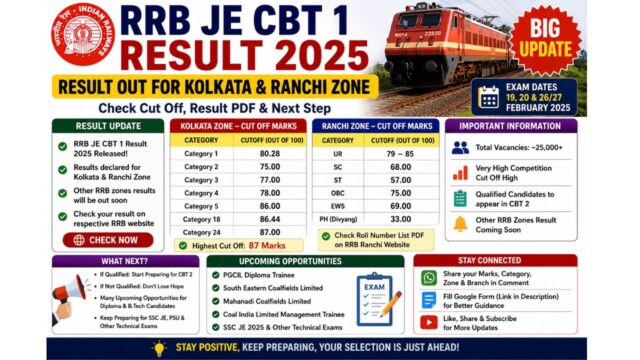
RRB Junior Engineer CBT 1 Result 2025 Finally Announced

The much-awaited CBT 1 results for the RRB Junior Engineer (JE) Recruitment 2025 has finally started releasing by the the Railway Recruitment Board (RRB). Candidates had been waiting for the result since the examination was conducted in February 2025.

The RRB JE CBT 1 examination was held on 19th, 20th, and 26th/27th February 2025 in multiple shifts across different centers in India. The students were very worried about the result delay after the March and April passed without any major updates. But Now, the good news is that some RRB zones have officially declared the CBT 1 results.

At present, the results for Kolkata and Ranchi zones have been finally released. Other RRB boards are expected to publish their results very soon, possibly by today evening or tomorrow.


Result Not Visible Yet? Don’t Panic

Many candidates are checking their regional RRB websites and not finding any update. There is no need to worry because all zones may not release the result at the same time.

For example:

  • RRB Ajmer website still does not show any result update.
  • RRB Patna website also has no latest notification regarding the JE CBT 1 result.

Candidates whose results are not yet available should wait patiently for the official update from their respective RRB board.


RRB JE 2025 Vacancy Details

This year, the RRB Junior Engineer recruitment was conducted for around 25,000 vacancies across India. Because the number of applicants was extremely high, the competition became very tough.

RRB JE CBT 1

Students have been continuously asking questions like:

  • “Will I qualify with these marks?”
  • “Is there any chance of selection?”
  • “What can be the expected cut off?”

Now, with the release of some official cut-offs, candidates can get a clear idea about their chances.


Kolkata Zone Cut Off Marks 2025

Kolkata had one of the highest numbers of vacancies this year. But even after having so many vacancies, the cut-off marks remained very high due to heavy competition.

Here are some important UR category cut-offs from Kolkata zone:

CategoryCut Off Marks
Category 180.28
Category 275
Category 377
Category 478
Category 586
Category 1886.44
Category 2487

This time, the highest cut-off reached around 87 marks, which is extremely high for CBT 1.

Such high cut-offs were previously seen in the 2018 RRB JE examination, especially in zones like Prayagraj where the vacancies were low.


Category Wise Cut Off – Kolkata

Some category-wise cut-offs from Kolkata zone are:

  • SC: Around 70 marks
  • ST: Around 65 marks
  • OBC: Around 76 marks
  • EWS: Around 71 marks

For a few categories where ST vacancies were higher, the ST cut-off dropped to nearly 62 marks.

This clearly shows that vacancy distribution also affects the final cut-off.


Ranchi Zone Cut Off Marks 2025

RRB Ranchi has also released the shortlisted candidates list and category-wise cut-offs.

Candidates can check their roll numbers in the official PDF available on the Ranchi RRB website.

Some important Ranchi cut-offs are:

CategoryCut Off Marks
UR79 – 85
SC68
ST57
OBC75
EWS69

Ranchi had fewer vacancies compared to Kolkata, so the competition remained strong there as well.

To Download the Score Card:- Click Here

To Download the Answer Key:- Click Here


Why Did the Cut Off Go So High?

The biggest reason behind the high cut-offs is:

1. Limited Vacancies

Although 25,000 vacancies sound large, the number of applicants was extremely high across India.

2. Easier CBT 1 Paper

Many students reported that the CBT 1 paper was moderate in difficulty, which increased average scores.

3. Serious Competition

Most candidates had already prepared for SSC JE, state engineering exams, and PSU exams, making the competition tougher.


What Should Non-Selected Candidates Do Now?

Candidates whose selection did not happen in CBT 1 should not lose hope.

This is not the end of opportunities. Many excellent technical recruitment exams are coming soon for both Diploma and B.Tech candidates.

Some major upcoming opportunities include:

  • PGCIL Diploma Trainee Recruitment
  • South Eastern Coalfields Limited
  • Mahanadi Coalfields Limited
  • Coal India Limited Management Trainee Recruitment
  • SSC JE 2025

Most of these recruitments require only a CBT examination and offer excellent salary packages.


Continue Your Preparation

Students are advised not to stop studying after one setback. The preparation done for RRB JE can also help in:

  • SSC JE
  • PSU exams
  • Coal India exams
  • State JE exams
  • Technical Assistant exams

Engineering aspirants from Electrical, Civil, Mechanical, and other branches should continue strengthening their technical subjects.


Coaching and Online Preparation Support

The speaker also suggested joining structured online courses for better preparation. Engineering candidates can join technical batches where all subjects are covered in detail.

Students can choose:

  • Live classes
  • Recorded lectures
  • Mock tests
  • Practice sessions
  • Complete technical subject preparation

According to the video, candidates can access engineering exam preparation courses through the Adda247, PW and some other platform. Discount coupons and long-duration subscriptions are also available for students preparing for upcoming exams.


Final Words

Now from today on wards, The RRB JE CBT 1 Result 2025 has finally started releasing zone-wise, bringing relief to thousands of candidates. Kolkata and Ranchi cut-offs clearly show that this year’s competition was extremely high.

It is strongly recommended that those candidates who qualified should immediately begin their preparation for CBT 2. Those who could not qualify should stay positive and continue preparing for upcoming engineering recruitment exams.

Remember, one result never decides your entire career. Consistent preparation and smart planning can open many better opportunities in the future.

- Advertisement -
Google search engine

APPLICATIONS

HOT NEWS

HDFC Bank Recruitment 2026: 10th, 12th Pass and Graduates Can Apply...

0
HDFC Bank has released a new recruitment notification for 2026, creating a great opportunity for candidates who want to build a career in the...