


Introduction: The Rise of the AI “Trillion-Dollar” Hype
In the last few years, artificial intelligence (AI) has become the biggest theme in global financial markets. Money has been flowing rapidly into AI-related companies, especially those connected to chips, cloud computing, and data centers. Investors believed that AI would keep growing without limits, creating endless profits.
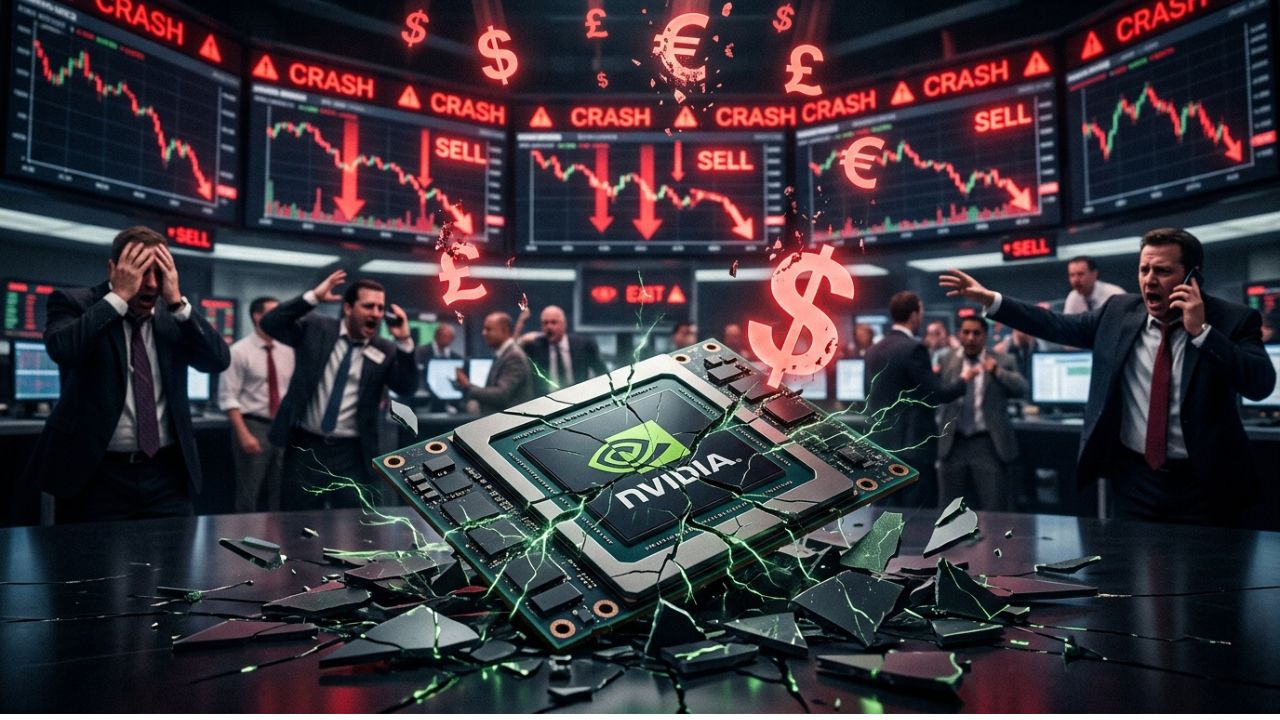
This excitement pushed many companies to extremely high valuations. For example, NVIDIA even crossed a market value of around $5 trillion, becoming one of the most valuable companies in the world. It looked like nothing could stop the AI boom. But recently, something changed. A sudden market fall raised an important question: Is the global AI bubble starting to burst?
A Sudden Shock in the Stock Market
In a single day, US stock markets saw a massive drop, especially in semiconductor and AI-related stocks. The total market value loss was around $1.3 trillion in just 24 hours. The biggest hit came in the tech-heavy NASDAQ index, which fell more than 4% in a day. Since NASDAQ mainly includes technology and growth companies, this fall showed strong pressure on the AI and chip sector.
Major companies like:
- NVIDIA
- AMD
- Intel
- Micron
- Broadcom
all saw sharp declines in their stock prices.
Some stocks fell by 6% to 17% in a single day, which wiped out hundreds of billions of dollars in value. This event is being seen as one of the biggest stress tests for the AI investment boom since 2023.
Why Semiconductor Companies Matter So Much
To understand this crash, we first need to understand why semiconductor companies are so important. Semiconductors (or chips) are the foundation of modern technology. They are used in:
- Smartphones
- Artificial intelligence systems
- Data centers
- Cloud computing
- Gaming and electronics
AI systems require extremely powerful computing capacity. This demand has created a huge need for advanced chips. That is why companies like NVIDIA and AMD became extremely valuable during the AI boom. When AI demand increased, chip demand also increased automatically.
In simple terms:
No chips = No AI revolution
The AI Boom That Created a Market Bubble
After the launch of tools like ChatGPT, AI adoption increased rapidly. Big companies started investing billions of dollars in AI infrastructure:
- Microsoft expanded AI investments
- Google increased AI spending
- Amazon built AI cloud services
- Meta invested heavily in AI data centers
Even in India, new data centers are being built in states like Andhra Pradesh. This created a massive demand for AI chips, pushing semiconductor stocks to record highs. For example, NVIDIA’s stock price grew from just a few dollars during the COVID period to over $200 in a few years. The growth was extremely fast and aggressive.
What Is a Market Bubble?
A financial bubble happens when investors push prices too high based on expectations rather than real profits. A bubble usually forms when:
- A new technology creates excitement
- Investors expect unlimited future growth
- Money flows too quickly into one sector
- Stock prices rise faster than real earnings
We have seen similar bubbles before:
- Railway boom
- Electricity revolution
- Dot-com internet bubble (1995–2000)
In all these cases, prices became unrealistic, and eventually the bubble burst. But importantly, the technology itself did not disappear. The internet survived and changed the world—even after the dot-com crash.
Is the AI Bubble Now Facing Reality?
Recently, investors have started worrying that AI valuations may have gone too high. There are three major concerns:
- Too much spending on data centers and chips
- High energy and infrastructure costs
- Unclear profit returns compared to massive investments
Even though AI usage is real and growing, investors are now asking:
👉 “Are profits matching expectations?”
The recent stock fall suggests that expectations were higher than reality. This does not mean AI is failing. Instead, it shows a reality check for overhyped valuations.
Impact on India’s Stock Market and Economy
Before 2023, foreign investors were heavily investing in India. But in the AI boom phase, a large amount of money shifted towards the US, South Korea, and Taiwan—countries leading in AI and chip production. This made India relatively less attractive for some time. India’s IT sector companies like:
- TCS
- Infosys
- Wipro
also faced pressure because AI started automating many IT services like coding, testing, and customer support. However, India’s economy is structured differently.
India depends more on:
- Consumption (cars, smartphones, goods)
- Infrastructure development
- Banking and financial services
- Manufacturing initiatives like “Make in India”
So India is not fully dependent on AI-driven valuations.
Can a Burst AI Bubble Actually Help India?
Interestingly, if the AI bubble corrects or bursts, it may benefit India in some ways. Here’s why:
- Investors may move money from overvalued AI stocks to stable economies
- India offers steady growth through consumption and infrastructure
- India is less dependent on AI hype cycles
- Long-term economic demand remains strong
So while AI-heavy markets may face corrections, India’s diversified economy could remain stable or even become more attractive.
AI Will Not Disappear
Even if the bubble bursts, AI will not end. Just like the internet after the dot-com crash, AI will:
- Continue to grow
- Become more practical
- Spread across industries
- Deliver long-term value
However, only strong and profitable companies will survive. Weak or overvalued companies may disappear.
Conclusion: A Reset, Not an End
The recent $1.3 trillion market drop shows that the AI sector is going through a correction phase. It is not the end of AI, but a reset of expectations. AI is a revolutionary technology, just like the internet. But every revolution goes through cycles of hype, overinvestment, correction, and then stable growth. The coming years will decide which companies truly deserve to lead the AI future.
In simple terms:
AI is not collapsing—it is adjusting to reality.