
Recent tensions in the Middle East have once again placed Pakistan at the center of international debate. Reports from major international media outlets suggest that Pakistan may have secretly helped Iran during the recent conflict involving the Israel, Iran, and America.
The issue has become serious because Pakistan was publicly trying to present itself as a mediator between America and Iran, while at the same time allegations are emerging that it allowed Iranian military aircraft to use Pakistani airbases for safety.
These reports have raised important questions about Pakistan’s real role in the conflict and whether the United States can still fully trust Islamabad.
The Allegation Against Pakistan
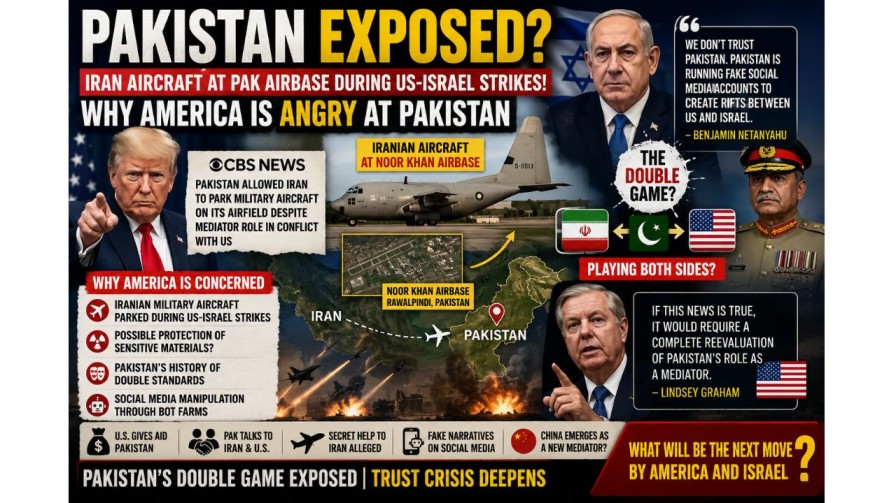
According to reports discussed by international media, an Iranian military aircraft was reportedly parked at Pakistan’s Noor Khan Airbase during the time when the United States and Israel were conducting military operations against Iran.
The aircraft was said to be an Iranian Air Force cargo plane, similar to the Hercules C-130 transport aircraft. Such aircraft are capable of transporting military equipment, supplies, and possibly sensitive materials.
The main controversy is not simply about an aircraft landing in Pakistan. The concern is whether Pakistan knowingly provided protection and shelter to Iranian military assets during a period of active conflict.
This has created anger in American political circles because Pakistan was simultaneously presenting itself as a neutral diplomatic partner.
Why Noor Khan Airbase Is Important
Noor Khan Airbase is one of Pakistan’s most strategic military bases. It has often been linked with sensitive military operations and international defense cooperation.
The airbase gained major attention earlier during regional military tensions when India reportedly targeted strategic Pakistani military infrastructure during Operation Sindoor.
Because of its strategic importance, any foreign military activity at Noor Khan immediately becomes an international issue.
Some analysts believe Iran may have considered the base safe because of Pakistan’s close military relationships with powerful countries, including China and the United States.
America’s Growing Suspicion
The United States has had a complicated relationship with Pakistan for many years. During the Afghanistan conflict, America frequently accused Pakistan of maintaining double policies — publicly supporting the US while secretly maintaining relations with groups working against American interests.
Now similar concerns are appearing again in the Iran situation.
American political leaders and defense experts are questioning whether Pakistan played a “double game” by helping Iran while also acting as a diplomatic bridge between Tehran and Washington.
US Senator Lindsey Graham reportedly stated that if these allegations are proven true, America may need to completely reconsider Pakistan’s role as a mediator in Middle East diplomacy.
This statement shows how seriously the issue is being viewed in Washington.
Pakistan’s Response
Pakistan has denied any wrongdoing.
Pakistani officials claim that Iranian aircraft arrived in the country only because diplomatic talks and delegations were taking place between Iran and international representatives in Islamabad.
According to Pakistan, the aircraft were being used for transportation related to diplomatic communication and not for military protection.
However, critics argue that the timing of the aircraft presence raises too many questions to ignore.
Israel’s Strong Reaction
Israel has also expressed deep distrust toward Pakistan.
Israeli Prime Minister Benjamin Netanyahu reportedly stated in an interview that Israel does not trust Pakistan’s role in the conflict.
Israel believes Pakistan may have tried to indirectly support Iran during the crisis.
Another major accusation made by Israel involves online propaganda and social media manipulation.
Claims of Social Media Manipulation
Israeli officials have claimed that fake social media campaigns were being run to create tension between America and Israel during the Iran conflict.
According to these allegations, some accounts pretending to be Western or American users were actually being operated from Pakistan through bot networks and coordinated digital campaigns.
These accounts allegedly spread narratives designed to:
- Increase anti-Israel sentiment
- Create confusion during the conflict
- Influence public opinion in America
The issue highlights how modern conflicts are no longer fought only with weapons but also through information warfare and online influence campaigns.
Pakistan’s Balancing Strategy
Pakistan has long tried to balance relations with multiple global powers at the same time.
It maintains ties with:
- The United States
- China
- Iran
- Gulf nations
This balancing strategy often helps Pakistan gain diplomatic and financial support from different sides. However, critics argue that this approach sometimes creates trust issues.
During the Afghanistan conflict, Pakistan faced similar accusations of supporting different sides simultaneously. Now observers believe a similar pattern may be emerging again in the Iran situation.
China’s Growing Role
As tensions continue, China is becoming increasingly important in the diplomatic process.
Iran has already shown support for China’s proposed peace framework for reducing tensions in the region.
China has presented a four-point peace proposal focused on:
- Dialogue
- Regional stability
- Ceasefire
- Diplomatic negotiations
Reports suggest the United States may also engage with China regarding future negotiations with Iran.
This shows how China is trying to increase its influence in Middle East diplomacy while America struggles to manage multiple regional crises.
Why the Situation Matters Globally
This controversy is important because it affects several major global relationships at once:
- America and Pakistan
- Iran and Pakistan
- Israel and Pakistan
- America and China
If the allegations against Pakistan become fully proven, it could damage Pakistan’s credibility internationally and affect future diplomatic cooperation with the United States.
At the same time, the issue also demonstrates how geopolitical alliances are becoming increasingly complex.
Countries are no longer operating in simple “friend vs enemy” categories. Instead, many nations are trying to maintain relationships with competing powers simultaneously for strategic benefit.
Conclusion
The reports surrounding Pakistan’s alleged support to Iran have created a new controversy in international politics. While Pakistan insists it only played a diplomatic role, many global observers remain suspicious about its true intentions.
The presence of Iranian aircraft at Noor Khan Airbase, accusations of digital propaganda, and America’s growing concerns have all added to the tension.
Whether these allegations are fully proven or not, the situation clearly shows how fragile international trust has become in modern geopolitics.
As the Middle East crisis continues to evolve, Pakistan’s actions will remain under close observation from the United States, Israel, Iran, and the wider global community.