
Home Blog Page 3

Why Is the Indian Rupee Falling? Understanding the Real Economic Crisis Behind Currency Weakness

0
Indian Rupee

Whenever the Indian Rupee falls against the US Dollar, headlines start appearing everywhere. At such times, many people remember a famous statement made by India’s Finance Minister: “The Rupee is not weakening, the Dollar is strengthening.” This statement is often used to explain the fall of the Rupee. The idea is that the problem is not with India, but with the increasing strength of the US Dollar.

But what if the reality is much bigger than that? What if the Indian Rupee is not only falling against the Dollar, but also against almost every major currency in the world? This raises a serious question: Is this only America’s story, or is there a deeper structural problem inside the Indian economy? Let us understand the complete picture in simple language.

Why Does a Falling Rupee Matter?

To understand this, imagine a simple example.

Earlier:

1 US Dollar = ₹80

Now:

1 US Dollar = ₹95

Technically, India’s GDP may still be growing. But practically, ordinary people become poorer. Why? Because India is heavily dependent on imports.

India imports:

  • Crude oil
  • Electronic chips
  • Machinery
  • Weapons
  • Solar panels
  • Technology products

Most of these items are purchased using Dollars. So when the Rupee weakens, all imported products become more expensive. This directly increases inflation and affects the daily lives of common people.

The Rupee Is Falling Against Many Currencies

The situation becomes more serious because the Rupee is not weakening only against the Dollar. It has also weakened against:

  • Euro
  • British Pound
  • Chinese Yuan
  • Japanese Yen
  • UAE Dirham
  • Singapore Dollar

In many cases, the Rupee has fallen by 15% to 25% against these currencies over the past year. This completely challenges the argument that only the US Dollar is becoming stronger. If the Rupee is falling against almost every major currency, then the problem is much deeper.

Main Reasons Behind the Falling Rupee

1. India’s Trade Deficit

India imports more goods than it exports. India earns foreign currency by exporting:

  • Software services
  • IT solutions
  • Some manufactured products

But India spends huge amounts on importing:

  • Oil
  • Gold
  • Electronics
  • Machinery
  • High-end technology

As a result, more Dollars leave India than enter India. When demand for Dollars increases and supply decreases, the Rupee naturally weakens.

2. Oil Dependency and Global Tensions

India imports nearly 80–85% of its crude oil needs.

At the same time, geopolitical tensions are increasing globally.

Some major global tensions include:

  • Middle East conflicts
  • Red Sea shipping disruptions
  • China-Taiwan tensions
  • Rising energy prices

Because of these problems, oil prices rise globally. When India buys more expensive oil from abroad, the pressure on the Rupee increases further.

3. US Federal Reserve Policies

Whenever the US Federal Reserve increases interest rates, global investors prefer investing in America. Why? Because US bonds provide:

  • Safer returns
  • Stable investment
  • Higher interest rates

As a result, foreign investors withdraw money from countries like India and invest in the US. This is called: Capital Outflow, When billions of Dollars leave Indian markets, the Rupee weakens sharply.

GDP Growth Does Not Always Mean Currency Strength

Many people ask: “If India’s economy is growing at 7–8%, then why is the Rupee weak?” This is an important question. Economic growth and currency strength do not always move together.

Indian Rupee

If growth is mainly based on:

  • Consumption
  • Imports
  • Spending

instead of manufacturing and exports, then the currency may still remain weak. India is currently one of the world’s largest consumer markets. We consume massive amounts of products, but many of the important components still come from abroad.

For example:

  • Mobile chips are imported
  • EV battery materials are imported
  • High-end electronics are imported

This creates structural weakness in the economy.

Lessons from China, Germany, and Japan

  1. Countries with strong currencies usually have strong manufacturing systems is China. China became the “factory of the world” through manufacturing exports.
2. Germany :- Germany strengthened its economy by exporting machinery and industrial products.
3. Japan:- Japan built global power through automobiles and electronics.

These countries created export-led growth models. India, however, still depends heavily on consumption and imports. That is why long-term currency strength remains a challenge.

Are Pakistan and Bangladesh Performing Better?

This topic has become very popular on social media. Some people claim that Pakistan and Bangladesh are performing better than India because their currencies are falling more slowly. But this comparison is misleading.

1. Pakistan:- Pakistan’s economy is currently surviving mainly through IMF loans and external support.
2. Bangladesh:- Bangladesh is also facing debt pressure and political instability.

However, some data shows that the pace of depreciation in their currencies was slower than the Indian Rupee during certain periods. This does not mean their economies are stronger than India. But it does create concern because India claims to become:

  • A 5 trillion dollar economy
  • A global economic power

Naturally, expectations from India are much higher.

The Biggest Impact on the Indian Middle Class

The real crisis is not only about exchange rates. The real crisis is the silent financial pressure on India’s middle class. When the Rupee falls:

  • Foreign education becomes expensive
  • International travel becomes costly
  • Imported gadgets become expensive
  • Petrol and diesel prices increase
  • Transportation costs rise
  • Food inflation increases

Even if salaries remain the same, purchasing power decreases. People slowly start feeling financially weaker.

What Can RBI Do?

The Reserve Bank of India (RBI) has some traditional tools to control currency weakness. These include:

1. Selling Dollars

RBI can sell foreign reserves to support the Rupee.

2. Changing Interest Rates

Higher interest rates can attract investors.

3. Market Regulation

RBI can intervene in currency markets. However, these are temporary solutions. The deeper structural problems still remain.

Long-Term Solutions for India

If India truly wants a stronger Rupee, then long-term reforms are necessary.

1. Boost Manufacturing

India must increase domestic production. “Make in India” should become stronger at the ground level.

2. Increase Exports

Indian products must become globally competitive. The world should buy more Indian goods and technology.

3. Reduce Oil Dependency

India must shift faster toward:

  • Green hydrogen
  • Renewable energy
  • Ethanol
  • Electric mobility

Reducing oil imports will reduce pressure on the Rupee.

4. Build Real Economic Capacity

Economic slogans alone are not enough. India needs:

  • Strong industries
  • Innovation
  • Technology leadership
  • Export power

Currency Is Also a Strategic Weapon

In today’s world, currencies are not just pieces of paper. Currencies represent:

  • Economic trust
  • Global respect
  • Strategic power

The US uses Dollar dominance as global influence. China uses Yuan diplomacy to expand its reach. BRICS countries are discussing de-dollarization strategies. If India wants to become a major global power, then a strong and stable currency becomes extremely important.

Final Thoughts

The falling Rupee is not just about the Dollar becoming stronger. It reflects deeper challenges inside India’s economy, including:

  • Import dependency
  • Weak manufacturing
  • High oil imports
  • Global investment risks

India still has huge potential because of:

  • Its large market
  • Young population
  • Growing economy
  • Expanding infrastructure

But long-term economic strength will only come when India focuses more on production, exports, and self-reliance. The real question is not: “How much has the Rupee fallen?”. The real question is: “Can India build an economy strong enough to support a powerful and respected currency in the future?”


300 Drones Near America? Cuba’s New Move Sparks Global Panic

0
CUBA

The most interesting and controversial country at the moment is Cuba. From communist revolution to Cold War tensions and from American sanction and military fear, Cuba has always been the headline in world news. Recently, a new report claimed that Cuba has developed around 300 military drones with the help of Russia and Iran. This news has once again increased tensions between Cuba and the United States. To understand why this report is important, we first need to understand Cuba’s history, its relationship with America, and the rise of leaders like Fidel Castro and Che Guevara.

Where is Cuba?

Cuba is a small island country located very close to the United States.

Nearby countries include:

  • The United States in the north
  • Mexico in the west
  • The Bahamas in the northeast

Its capital city is Havana.

Cuba is famous for:

  • Sugar production
  • Old vintage cars
  • Beaches and tourism
  • Communist government
  • Fidel Castro and the Cuban Revolution

How Christopher Columbus Changed Cuba

Before European arrival, Cuba was home to indigenous tribes of the Taíno and Ciboney people. Everything changed in 1492 when Christopher Columbus arrived during his expedition funded by Spain. Unlike the many European explorers of that time, Columbus was searching for a sea route to India but accidentally reached the Americas. Soon after, that Spain took control of Cuba around 1508.

Spanish Rule and Sugar Economy

For almost 400 years, Spain ruled Cuba. The Spanish realized that Cuba’s climate was perfect for sugar farming. Huge sugar plantations were created, and enslaved Africans were brought to work in the fields. Cuba slowly became one of the world’s biggest sugar-producing regions, often called the “Sugar Capital of the World.” But the local population suffered heavily under colonial rule.

America Enters Cuba

In 1776, United States became independent from Britain and then began to expand its influence into its neighboring countries. By 1898, the US fought a war against Spain known as the Spanish-American War. America defected the Spanish and remove them from the Cuba. However, instead of complete freedom, Cuba came under strong American influence. From 1898 onward, the US controlled many political and economic activities in Cuba.

Batista’s Dictatorship

The United States supported a leader named Fulgencio Batista, who became Cuba’s ruler. Batista ruled for many years with strong American backing.

During his rule:

  • Corruption increased
  • Political opposition was crushed
  • America gained major business benefits in Cuba

The US also gained control of Guantanamo Bay, which later became one of America’s biggest naval bases. Even today, Guantanamo Bay remains under US control.

Rise of Fidel Castro and Che Guevara

Many Cubans were unhappy with Batista’s dictatorship. A young lawyer named Fidel Castro, along with his brother Raul Castro and revolutionary Che Guevara, started a rebellion against the government. Using guerrilla warfare, they attacked government forces and slowly gained public support. Finally, in 1959, Batista fled Cuba, and Fidel Castro came to power. This event became famous as the Cuban Revolution.

CUBA

Why America Was Afraid of Cuba

America became extremely worried after Fidel Castro took power because Cuba was now becoming a communist country very close to the US border. At that time, the Cold War between the United States and the Soviet Union was already happening. The Soviet Union started helping Cuba with money, weapons, and political support. America feared that communism was spreading near its territory.

Bay of Pigs Invasion

In 1961, the US tried to overthrow Fidel Castro through a failed operation called the Bay of Pigs invasion. America trained Cuban exiles and sent them to attack Cuba. But Castro’s forces defeated them quickly. This became one of America’s biggest failures during the Cold War.

Cuban Missile Crisis

The situation became even more dangerous in 1962 during the Cuban Missile Crisis. The Soviet Union secretly placed nuclear missiles in Cuba to protect it from possible American invasion. For 13 days, the world came close to nuclear war between the US and the Soviet Union. Finally, both sides stepped back, and the crisis ended peacefully. But this event showed how important Cuba was in global politics.

Cuba’s Economic Problems

Although Fidel Castro remained in power for decades, Cuba faced serious economic problems. America imposed heavy sanctions on Cuba, limiting trade and business opportunities.

Today, Cuba faces:

  • Poverty
  • Shortage of goods
  • Weak economy
  • Old infrastructure
  • Limited private business

Many people still drive vintage cars from the 1960s and 70s because newer vehicles are expensive. For many years, Cubans were not even allowed to freely run private businesses.

Tourism and Daily Life

Despite economic struggles, Cuba remains popular among tourists.

Tourists often visit for:

  • Beaches
  • Music and culture
  • Classic cars
  • Historical buildings

Tourism is very important for Cuba’s economy. However, many parts of Havana remain underdeveloped and poorly maintained.

The New Drone Report

Recently, reports claimed that Cuba has developed around 300 military drones with support from Russia and Iran. This has shocked many people because Cuba is located very close to America. Some experts believe these drones could threaten US military operations, especially near Guantanamo Bay. However, there is currently no public evidence that Cuba is planning an attack on America. No major military mobilization or missile deployment has been confirmed.

Why the Report Matters

Many analysts believe the report may increase tensions between America and Cuba. Former US President Donald Trump has often taken a tough stance against Cuba. Some people think America may use such reports to justify stronger actions or sanctions against Cuba in the future. At the same time, Cuba continues to maintain close relations with Russia and Iran.

Final Thoughts

Cuba’s history is full of revolution, foreign control, Cold War conflict, and economic struggle. From Spanish colonial rule to Fidel Castro’s communist revolution, Cuba has remained one of the world’s most politically important islands. Today, the country still faces economic hardship and international pressure. The new drone report has once again placed Cuba in the global spotlight. Whether this situation becomes a serious conflict or only political tension will depend on future relations between Cuba, America, Russia, and Iran.

Google AntiGravity AI Coding IDE: A Powerful New Tool for Developers

0
Google AntiGravity
Google AntiGravity

Hello friends, In the AI world of coding tools, Google has introduced its new brand platform which is Google Antigrivity. Many experts comparing it with popular AI coding IDEs like Cursor, Windsurf, and VS Code-based AI tools. But instead of simply calling it a “Cursor Killer” or “VS Code Killer,” it is better to understand what this tool actually offers and how useful it can be for developers.

So get ready because in this article we will explore the features of Google AntiGravity, how it works, its strengths, its weaknesses, and whether it can truly change the future of software development.

What is Google AntiGravity?

Google Antigravity is an AI-powered coding IDE that uses intelligent agents to help developers build applications. It combines coding assistance, planning, browser automation, image generation, and debugging into one platform.

Google AntiGravity

Currently this tool is free to use and comes with powerful AI models such as Gemini 3 Pro and Nano Banana Pro for advanced coding and design generation. The installation process is very simple. Users can download the IDE, install it like a normal application, sign in using their Google account, and start coding immediately.

Different Working Modes in AntiGravity

One of the most interesting features of the AntiGravity is that it offers multiple AI working modes depending on how much control you want to give to the AI agent.

1. Agent-Driven Development

In this mode, the AI agent works almost completely independently. It performs tasks automatically without constantly asking for approval.

2. Agent-Assisted Development

Here, the AI occasionally asks for reviews and confirmations while working.

3. Review-Driven Development

This mode gives more control to the user. The AI asks for approval more frequently before making changes.

4. Custom Configuration

Users can fully customize how the AI behaves and when it should ask for permission. This flexibility makes the IDE suitable for both beginners and experienced developers.

Planning Mode vs Fast Execution Mode

AntiGravity also provides two important execution styles:

1. Planning Mode

In this mode, the AI first creates a detailed implementation plan before writing code. It thinks carefully and improves accuracy.

2. Fast Execution Mode

This mode starts coding immediately for quicker results. However, the accuracy may be lower compared to planning mode. For complex projects, planning mode is highly recommended because it produces more organized and reliable outputs.

AI-Powered Website Creation

One of the most impressive features demonstrated in AntiGravity is its AI-generated website development. For example, when the AI was asked to: “Create a React app for a restaurant and generate homepage design variations.” Within minutes, its the tool started generating multiple homepage concepts automatically using AI-generated artifacts. The user can review different design options, select the preferred one, and ask the AI to continue development based on that design. This makes the development process much faster and easier, especially for frontend development.

Smart AI Planning System

Before coding begins, AntiGravity creates a full development roadmap. For example, while building the restaurant app, the AI automatically planned:

  • Homepage development
  • Menu page creation
  • Reservation page
  • Contact page
  • About page
  • Team page

Users can even comment on the AI’s plan and request additional features before execution starts. This collaborative planning system feels very advanced and useful.

Agent Manager: Multi-Tasking with AI

Another powerful feature is the Agent Manager. Using shortcuts like Ctrl + E, users can open the Agent Manager and run multiple AI tasks simultaneously.

For example:

Google AntiGravity
  • One AI agent can generate a website
  • Another agent can create food images
  • Another can organize folders and assets

All these tasks run in parallel without interrupting each other. This significantly improves productivity.

AI Image Generation Inside the IDE

AntiGravity can even generate images directly inside projects. For example, the AI was asked to: “Create high-quality food item images and save them inside the IMG folder.” The AI automatically generated images like:

  • Pizza
  • Pasta
  • Burgers

And stored them in the correct project folder. This feature is extremely useful for developers who need quick design assets during development.

Browser Automation and Testing

One of the biggest innovations in AntiGravity is browser integration. The IDE can open a browser, install its extension, launch the web application, and test it automatically.

The AI agent can:

  • Navigate through pages
  • Detect frontend errors
  • Read browser logs
  • Take screenshots
  • Analyze DOM elements
  • Fix issues automatically

This is a major improvement compared to traditional AI coding tools because most tools only understand terminal logs, not browser behavior.

By combining:

  • Frontend logs
  • Backend logs
  • Browser screenshots
  • DOM analysis

Google’s AI creates a much smarter debugging system.

Custom Rules and Personalization

Users can also create custom development rules.

For example:

  • Use purple color theme
  • Follow specific UI guidelines
  • Apply custom design systems

These rules are saved and automatically followed by the AI during future development. This makes the tool highly customizable.

Weaknesses and Problems

Although AntiGravity is powerful, it is not perfect. Several issues were noticed during testing:

1. Weak UI Design Quality

The generated website designs were not always polished. Some layouts looked incomplete or visually weak.

2. Browser Profile Limitation

The AI opens a separate browser profile instead of using the user’s personal Chrome profile.

3. Error Detection Issues

Sometimes the AI fails to properly detect console errors and may enter repetitive debugging loops.

4. Inconsistent Styling

Some UI elements may break or disappear after updates and fixes. So while the tool is impressive, it still requires improvements.

Is AntiGravity a VS Code or Cursor Killer?

The simple answer is: No. AntiGravity is not a “killer” for Cursor, VS Code, or Windsurf. It is simply another strong competitor in the AI coding market. Tools like Cursor have years of experience, large datasets, and mature ecosystems. Google’s AntiGravity is still in its early stages. However, the competition is good for developers because it pushes companies to create better AI tools.

Will AI Replace Developers?

Google AntiGravity

This is one of the biggest questions today. The answer is: Not anytime soon. AI tools like AntiGravity are designed to assist developers, not replace them completely. Human creativity, problem-solving, experience, and decision-making are still extremely important. AI can speed up coding and automate repetitive tasks, but developers who continue learning fundamentals will always stay valuable.

Final Thoughts

Google AntiGravity is an exciting new AI coding IDE with powerful automation features. Its ability to combine:

  • AI coding
  • Planning
  • Browser testing
  • Image generation
  • Multi-agent workflows

makes it one of the most innovative tools currently available. Even though it still has bugs and design limitations, its future looks very promising. For developers, the best approach is not to fear these tools, but to learn how to use them effectively. AI will continue evolving, and developers who adapt early will benefit the most.

Big Opportunity! SBI Apprentice Recruitment 2026 for 7150 Vacancies Explained

0
SBI Apprentice

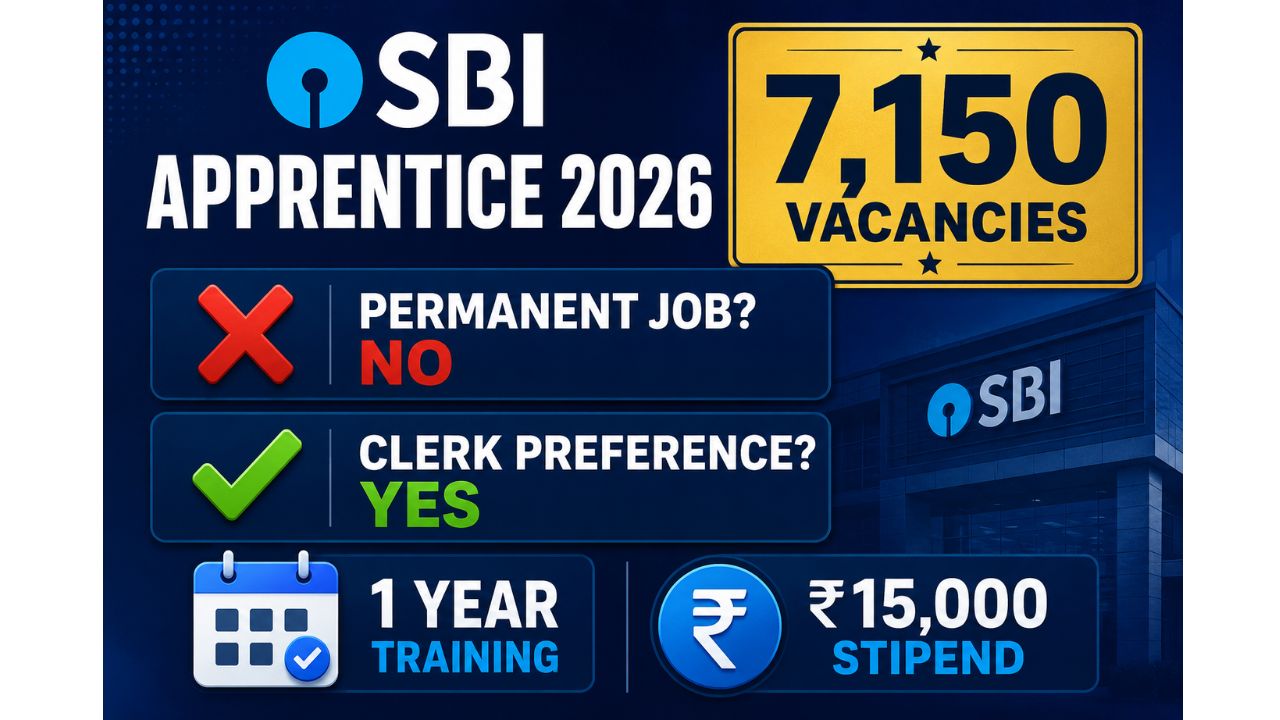
The State Bank of India (SBI) has officially announced 7150 SBI Apprentice vacancies under the Apprentice Act 1961. This is one of the biggest apprenticeship recruitment drives by SBI in recent times. Many students are confused about whether they should apply for this recruitment or not. Is it a permanent job? What are the benefits? What are the disadvantages? Can this help in future SBI Clerk recruitment?

In this article, we will discuss everything about the SBI Apprentice Recruitment 2026.

What is SBI Apprentice Recruitment?

The SBI Apprentice program is a one-year training program in which selected candidates work inside SBI branches and learn banking operations. The work of an apprentice is almost similar to the work of an SBI Clerk. Apprentices help in:

  • Customer service
  • Basic banking operations
  • Account-related tasks
  • Office work
  • Branch support activities

So, in terms of work profile, apprentices perform many duties similar to clerks.

Is This a Permanent Job?

This is the most important question. The answer is No. SBI Apprentice is not a permanent job. It is only a one-year temporary training program. After completing one year, the apprenticeship ends automatically.

The official notification clearly mentions that apprentices will not be treated as permanent employees of SBI. So, students should apply only after understanding this point properly.

Major Benefit of SBI Apprentice

Even though it is not a permanent job, there is one very important benefit. Candidates who successfully complete the SBI apprenticeship receive preference in future SBI Clerk (Junior Associate) recruitment. According to the notification, apprentices may receive:

  • Extra weightage
  • Relaxation
  • Bonus preference in recruitment

This benefit is mainly useful during the SBI Clerk Mains Examination. This means candidates who complete the apprenticeship may get an advantage over other competitors in future SBI Clerk recruitment. For students who are serious about getting a permanent SBI Clerk job, this can be a very useful opportunity.

Who Should Apply for SBI Apprentice?

This recruitment is not for everyone. It is important to understand whether it suits your situation or not.

You Should Apply If:

1. You Need Financial Support

SBI will provide a monthly stipend of ₹15,000 during the apprenticeship period. This amount may not be very high, but it can help students who currently need financial support.

2. You Want to Prepare for Banking Exams

The syllabus of SBI Apprentice is very similar to:

  • SBI Clerk
  • IBPS Clerk
  • Banking exams

Subjects like:

  • Quantitative Aptitude
  • Reasoning
  • English
  • General Awareness

are common in all banking exams. So, candidates can continue preparing for future banking exams while doing the apprenticeship.

3. You Want a Career in SBI

If your final target is SBI Clerk or another SBI job, then this apprenticeship can give you valuable banking experience and future recruitment benefits.

Who Should Avoid This Recruitment?

You should think carefully before applying if:

SBI Apprentice
  • You cannot manage job and study together
  • You are expecting a permanent job immediately
  • You are not interested in banking exams later

Remember, after one year the apprenticeship ends. If your preparation also stops during that time, you may again face job struggles. So proper planning is very important.

Total Vacancies

SBI has announced a total of:

7150 Apprentice Vacancies

The vacancies are distributed state-wise and category-wise across India. Candidates can check detailed vacancy information in the official notification PDF available on SBI Careers website.

Eligibility Criteria

Educational Qualification

Candidates must have completed: Graduation from a recognized university, The graduation result must be available on or before: 1 April 2026. Final year students whose results are not declared are not eligible.

Age Limit

Minimum Age:

20 Years

Maximum Age:

28 Years

The candidate must be born between:

  • 2 April 1998
  • 1 April 2006

Reserved category candidates will receive age relaxation as per government rules.

Training Duration

The apprenticeship duration is:

1 Year

After completion, the apprenticeship automatically ends. Also, candidates who have already completed SBI Apprenticeship earlier generally cannot apply again.

Salary and Benefits

Selected apprentices will receive:

₹15,000 per month stipend

However, apprentices will not receive additional employee benefits like:

  • HRA
  • Medical benefits
  • Pension
  • Special allowances
  • Employee perks

Because apprentices are not treated as regular SBI employees.

Selection Process

The SBI Apprentice selection process includes:

1. Online Written Examination

The exam will contain:

SubjectQuestionsMarks
General & Financial Awareness2525
General English2525
Quantitative Aptitude2525
Reasoning Ability & Computer Aptitude2525

Total:

  • 100 Questions
  • 100 Marks

Each section will have:

15 Minutes Sectional Timing

Local Language Test

Candidates must know the local language of the state they are applying for. However, candidates who studied that local language in:

  • Class 10th
    or
  • Class 12th

may not need to appear for the language test. Other candidates may have to clear the local language test.

Medical Examination

After clearing the online exam and language test, candidates must also pass:

Medical Examination

Final selection will depend on:

  • Online Exam Score
  • Language Test
  • Medical Fitness

Important Reality About This Recruitment

The official notification clearly says: “This is not employment in the bank.” This means apprentices are trainees, not permanent SBI staff members. So students should not misunderstand this recruitment as a direct permanent banking job.

Preparation Strategy

If your target is only SBI Apprentice, then expensive paid courses may not be necessary. There is plenty of free preparation material available on YouTube for:

  • Quant
  • Reasoning
  • English
  • Banking Awareness

With proper discipline, many students can prepare from free resources. However, if your target includes:

  • SBI Clerk
  • IBPS PO
  • Other banking exams

then joining a proper banking preparation batch may help.

Final Conclusion

SBI Apprentice Recruitment 2026 is a good opportunity for candidates who:

  • Need temporary financial support
  • Want banking experience
  • Are preparing for SBI Clerk
  • Want future advantage in SBI recruitment

But candidates must remember that this is not a permanent job. The biggest advantage is the future preference and possible bonus weightage in SBI Clerk recruitment after successfully completing the apprenticeship.

So before applying, students should carefully evaluate their goals, financial situation, and ability to continue preparation alongside the apprenticeship.

Pakistan Deploys Troops in Saudi Arabia Amid Iran Conflict: What Is Happening in West Asia?

0
Pakistan Deploys Troops

Introduction

The ongoing conflict has created an atmosphere of tension in West Asia. Until recently, Pakistan tried to act as a mediator between different countries involved in the crisis. However recent reports have revealed that Pakistan has taken a more direct role by deploying troops, fighter jets, drones, and air defense systems inside Saudi Arabia.

According to reports from Reuters and other international media agencies, Pakistan has sent around 8,000 troops to Saudi Arabia. The report also suggests that Pakistan has deployed fighter jets, drones, and air defense systems to Saudi Arabia.
And these latest developments have raised serious questions about whether the conflict in the Middle East could expand further in the coming days.

Why Pakistan Has Deployed Troops in Saudi Arabia

Reports suggest that Pakistan fears Iran may target Saudi Arabia in the future. Recently, Iran reportedly carried out attacks connected to regional tensions involving the United Arab Emirates. Because Saudi Arabia is a close ally of the United States, there are concerns that Iran could also increase pressure on Saudi targets.

At the same time, former US President Donald Trump posted maps and military visuals on social media showing strong American military presence across the Gulf region. This has further increased tensions in the area. Experts believe Pakistan’s deployment is mainly aimed at supporting Saudi Arabia if the situation becomes more dangerous.

What Has Pakistan Sent to Saudi Arabia?

According to security sources quoted in international reports, Pakistan has deployed:

Pakistan Deploys Troops
  • Around 8,000 troops
  • JF-17 fighter jets
  • Military drones
  • HQ-9 air defense systems
  • Air force personnel and advisors

The JF-17 fighter jet is jointly developed by Pakistan and China. The HQ-9 is a Chinese-made air defense system designed to intercept missiles and aircraft. Reports also suggest that two drone squadrons have been placed inside Saudi Arabia as part of the deployment.

Pakistan Says It Is Following a Defense Agreement

Pakistan has claimed that troops may be deployed to Saudi Arabia under a mutual defense agreement signed with Saudi Arabia. According to this agreement, Pakistan will provide security to Saudi Arabia in case of threats or attacks. Some of the reports also suggest that the situation may become worse if Pakistan increases the number of its 80K troops in the near future.

It is even being said that Pakistan is ready to send its warships if Saudi Arabia requests naval support. However, no large naval movement has been officially confirmed yet.

Questions Over Pakistan’s Role as a Mediator

One major question being discussed is Pakistan’s role as a “mediator.” Normally, a mediator is expected to maintain balanced relations with both sides of a conflict. But critics argue that Pakistan is now clearly supporting Saudi Arabia and the American bloc.

This raises an important question: How can Iran trust Pakistan as a neutral mediator if Pakistan is openly deploying military assets in Saudi Arabia? Many analysts believe this deployment weakens Pakistan’s diplomatic position and increases distrust between Iran and Pakistan.

Why Experts Believe the Situation Is Serious

Experts say such a heavy military deployment cannot be described as only an “advisory mission.” Sending thousands of troops, fighter jets, drones, and air defense systems usually indicates preparation for possible combat operations.

Security analysts believe:

  • Saudi Arabia is preparing for possible escalation
  • Pakistan is ready to provide military support if needed
  • Gulf countries fear wider regional attacks

This suggests that many countries in West Asia are preparing for a more dangerous phase of the conflict.

Iran’s Position and Regional Tensions

Currently, Iran has attacked several Gulf countries for supporting American military operations in the region. If tension increases like this then Iran may see Saudi Arabia as part of the anti-Iran coalition because of its close ties with the United States.

At the same time, Iran is also strengthening its military readiness. And this has created a fear-filled atmosphere of larger regional conflicts involving multiple countries across the Middle East.

Concerns About Pakistan’s Military Capability

Some critics have questioned whether Pakistan’s military deployment can actually provide strong protection to Saudi Arabia. Questions have also been raised about the effectiveness of the Chinese-made HQ-9 air defense system after earlier regional conflicts where missile interceptions reportedly failed.

Still, Saudi Arabia appears willing to rely on Pakistan for additional manpower and support.

What Could Happen Next?

Many analysts believe the next few days or weeks could be very important. Possible scenarios include:

  • Increased attacks in the Gulf region
  • Iranian pressure on Saudi targets
  • Expansion of military deployments
  • More involvement from the US and allied countries
  • Naval operations in the Gulf

Because of these risks, several countries are now increasing military readiness.

America’s Role in the Conflict

The United States continues to maintain a strong military presence across West Asia. American bases in Gulf countries remain highly active, and US support for allies such as Saudi Arabia and the UAE continues.

This has further increased tensions with Iran, which sees American military expansion in the region as a direct threat.

Growing Fear of a Bigger Regional War

The latest developments show that the Iran conflict is no longer limited to one country. Now multiple nations are becoming directly or indirectly involved, including:

Pakistan Deploys Troops
  • Iran
  • Saudi Arabia
  • Pakistan
  • United States
  • UAE
  • China

This increases the risk of a wider regional conflict that could affect global oil prices, trade routes, and international security.

Final Thoughts

Pakistan’s troop deployment in Saudi Arabia marks a major shift in the ongoing West Asian conflict. Although Pakistan still claims to support peace and mediation, its military actions suggest stronger alignment with Saudi Arabia and the US-led bloc.

At the same time, Iran is increasing its own preparations, and tensions across the Gulf continue rising. Whether the situation turns into a larger regional war or remains limited will depend on diplomatic efforts and military decisions taken in the coming weeks.

India’s Biggest Offshore Oil Hunt Begins: Can It Reduce India’s Energy Dependence?

0
Offshore Oil

Introduction

From the most recent news and updates, we learned that Government of India is preparing to launch one of the biggest offshore oil and gas exploration projects in the country’s history. According to sources, the government of India is soon to conduct a massive survey of offshore energy reserves to discover how much untapped oil and natural gas is hidden beneath Indian waters.

At present, India’s dependence on crude oil is continuously increasing and this move has become extremely important at a time when rising global tensions, energy insecurity, and economic pressure have made energy independence a major national priority.

The upcoming survey is expected to cover lakhs of kilometers across India’s offshore regions and that could completely change India’s future energy needs if major oil and gas reserves are discovered.

Why This Survey Is Important

Currently, India imports its crude oil needs from other countries. Although India’s domestic oil production has increased slightly over the years, But the country’s oil demand has also increased at the same pace. As a result, the gap between domestic production and total consumption has become very large.

This has made India highly dependent on imported crude oil.

India’s Oil Import Dependence Is Rising

Data shows that India’s crude oil import dependence has increased steadily in recent years.

Crude Oil Import Dependence

YearImport Dependence
2018-1983.8%
2024-2588.2%
Current EstimateAround 90%

This means India imports nearly 90% of the crude oil it consumes. Back in 2015, the government had announced a target to reduce oil import dependence from 77% to 67% by 2022. However, the target was not achieved, and dependence has continued to rise instead.

Domestic Oil Production Has Stagnated

India’s domestic crude oil production has remained almost stagnant during the last few years.

In 2019-20:

  • India produced around 13% of its oil demand domestically.

Today:

  • Domestic production has fallen to nearly 11% of total demand.

This clearly shows that India’s energy consumption is growing much faster than its domestic production capacity.

Major Oil-Producing Regions in India

Currently, most of India’s domestic crude oil production comes from:

  • Mumbai High Offshore Basin
  • Assam Basin
  • Cambay Basin in Gujarat
  • Cauvery Basin
  • Rajasthan Basin

However, experts believe India still has huge untapped offshore reserves that have never been properly explored.

The 2024 Report That Changed the Discussion

A major report released by S&P Global Commodity Insights in 2024 highlighted India’s massive unexplored hydrocarbon potential.

According to the report:

  • India has explored only around 10% of its sedimentary basins.
  • Large offshore regions remain almost untouched.
  • India may hold around 22 billion barrels of oil potential.

This potential is believed to exist in areas such as:

  • Mahanadi Basin
  • Andaman Sea
  • Bay of Bengal
  • Kerala-Konkan region
  • Krishna-Godavari Basin

Many of these regions have never even been fully surveyed before.

Government Launching India’s Biggest Offshore Energy Survey

The Indian government has finally decided to act on this problem. So now Govt of India is launching the biggest and largest offshore oil and gas surveys ever conducted since independence. This survey involves specialized survey ships that will scan deep underwater to identify commercially viable oil and natural gas reserves.

This survey will scan not only shallow areas but also deep underground layers beneath the seabed because large hydrocarbon reserves may be buried at great depths.

Areas That Will Be Surveyed

The focus will mainly be on offshore regions that were previously ignored.

Offshore Oil

Major Survey Areas

  • Bengal Basin
  • Purnia Basin
  • Mahanadi Basin
  • Krishna-Godavari Basin
  • Cauvery Basin
  • Andaman Offshore Basin

These areas are believed to contain huge untapped hydrocarbon reserves.

Scale of the Survey

The scale of this project is massive.

Estimated Survey Coverage

RegionSurvey Coverage
Bengal-Purnia-Mahanadi45,000 line km
Andaman Basin43,000 line km
Krishna-Godavari Basin43,000 line km
Cauvery Basin3,000 line km

Overall, the project will cover lakhs of kilometers and may take nearly two years to complete.

Technical Name of the Project

The government of India has already floated the tender market for this project. and the The technical name of the survey is: “2D Broadband Seismic and Gravity-Magnetic Data Acquisition, Processing and Interpretation.” And the main objective is very simple that just identify commercially viable oil and natural gas reserves hidden deep beneath the ocean floor.

Why This Could Be a Game Changer

If the survey confirms large oil and gas reserves, it could transform India’s energy sector.

Possible benefits include:

  • Reduced oil import dependence
  • Lower pressure on foreign exchange reserves
  • Better energy security
  • Reduced impact of global oil shocks
  • Stronger economy
  • Lower vulnerability during international conflicts

India currently faces serious risks whenever global oil prices rise because the country imports most of its energy needs. Finding domestic reserves could reduce this pressure significantly.

India Is Also Working on Other Energy Projects

Apart from offshore exploration, India is also working on several other energy security projects.

These include:

1. Deep-Sea Gas Pipeline from Oman

India is planning deep-sea gas connectivity projects to reduce dependence on vulnerable trade routes like the Strait of Hormuz.

2. Coal Gasification Projects

The government has also approved coal gasification projects to convert coal into cleaner fuel alternatives.

3. Renewable Energy Expansion

India is rapidly investing in solar, wind, and green hydrogen sectors to diversify energy sources.

Energy Crisis as an Opportunity

Recent global conflicts and energy crises have shown how dangerous excessive import dependence can become.

Whenever global oil prices rise:

  • Inflation increases
  • Fuel becomes expensive
  • Transportation costs rise
  • Economic growth slows down

This crisis has now pushed India to seriously explore its untapped domestic energy potential.

Final Thoughts

India’s upcoming offshore oil and gas survey could become one of the most important energy projects in the country’s history. For decades, large offshore regions remained unexplored despite having huge hydrocarbon potential. Now, with rising global uncertainty and increasing energy demand, India is finally moving aggressively to discover its own reserves.

If major oil and gas reserves are found, it could reduce India’s import dependence and strengthen the country’s long-term energy security. The next two years may therefore play a very important role in shaping India’s energy future.

Railway Technician Recruitment 2026: Big Changes Expected in Railway Exams, Science Weightage to Increase

0
Railway Technician Recruitment

A major recruitment update has come from the railways side. The Railway Recruitment Board (RRB) is planning some important changes in upcoming exams like ALP, Technician, JE, and even Group D. According to recent news and notification, the weightage of General Science may increase significantly, while General Awareness questions may be reduced or completely removed in some technical exam.

This is a very important change for all Railway aspirants because now students will need to focus more on Science subjects instead of History, Polity, Economics, and Current Affairs.

General Awareness May Be Removed from Technical Exams

Recently, in the RRB ALP notification, it was clearly mentioned that questions from General Awareness may not be asked. This means subjects like:

  • History
  • Polity
  • Economics
  • Geography
  • Current Affairs

may not appear in exams like ALP and Technician.

Instead, Railway may focus more on:

  • Physics
  • Chemistry
  • Biology
  • Technical Science Concepts

Experts believe that this pattern can also be applied to:

  • Technician Grade 1
  • Technician Grade 3
  • Junior Engineer (JE)
  • Group D exams

If this happens, then Science will become the most important subject in Railway exams.

Career Will Science Channel for Free Preparation

To help students prepare for this changing pattern, a new YouTube channel called “Career Will Science” has been launched.

The channel mainly provides:

  • One-shot Science lectures
  • PYQ (Previous Year Questions) practice
  • Physics, Chemistry, and Biology concepts
  • Long detailed concept videos

Unlike short 10–15 minute videos, the channel focuses on deep learning with detailed explanation.

Some popular videos include:

  • Mass, Weight and Density (almost 3-hour lecture)
  • 100 Best Chemistry PYQs for RRB NTPC
  • 100 Best Biology Questions
  • Top Physics PYQs

Students preparing for Railway exams can benefit a lot from these free resources.

RRB Technician Recruitment 2026 Overview

RRB has released a short notice for Technician Recruitment 2026.

Total Vacancies

A total of 6565 vacancies are expected.

Vacancy Distribution

PostVacancies
Technician Grade 36242
Technician Grade 1323

Compared to previous years:

YearVacancies
202414,298
20256,238
20266,565

Although the increase is small, vacancies are becoming more stable every year.

Important Dates

RRB had already hinted about this recruitment on 30 March 2026.

Railway

Expected Timeline

EventDate
Detailed Notification30 June 2026
Online Form Start30 June 2026

Railway recruitment is slightly delayed compared to the official calendar, but the process is moving forward steadily.

Upcoming recruitments may include:

  • Section Controller
  • Junior Engineer (JE)
  • NTPC Graduate & Undergraduate
  • Group D Recruitment

According to expectations:

  • NTPC vacancies may come around August 2026
  • Group D vacancies may come around October 2026

Eligibility Criteria

Technician Grade 1 Eligibility

Candidates must have:

  • B.Sc in Physics, Electronics, or Computer Science
    OR
  • Engineering Diploma

Age Limit

18 to 33 years

Salary

Basic Pay: ₹29,200

Expected in-hand salary can reach around ₹65,000 per month with allowances.

This is a Pay Level 5 job.

Technician Grade 3 Eligibility

Candidates need:

  • 10th Pass
  • ITI in relevant trade

Age Limit

18 to 30 years

Salary

Basic Pay: ₹19,900

Expected first salary may be around ₹42,000 per month.

This is a Pay Level 2 post.

Expected Exam Pattern Changes

The biggest discussion is about changes in the syllabus.

Earlier Pattern

General Awareness used to carry around 10 questions.

But now there is a strong possibility that these questions may be removed from technical exams.

If that happens, those marks may be added to General Science.

Technician Grade 1 Expected Pattern

Subjects may include:

  • Mathematics
  • Reasoning
  • Basic Science & Engineering
  • Computer Knowledge

General Awareness may be removed.

Technician Grade 3 Expected Pattern

Expected subjects:

SubjectQuestions
Mathematics25
Reasoning25
General Science50

Science may become the highest-weightage section.

This is why students are now advised to focus seriously on Physics, Chemistry, and Biology.

Exam Pattern Details

The exam will likely remain:

  • Computer Based Test (CBT)
  • 100 Questions
  • 90 Minutes Duration
  • 1/3 Negative Marking

That means for every 3 wrong answers, 1 mark will be deducted.

Important Trades in Technician Recruitment

Some major trades include:

Railway Technician Recruitment
  • Diesel Mechanic
  • Fitter
  • Welder
  • Electrician
  • Electrical TRS
  • Bridge Technician
  • Carriage & Wagon
  • Signal & Telecom
  • Refrigeration & AC

Work Profile of Railway Technicians

Selected candidates may work in:

  • Railway workshops
  • Signal systems
  • Electrical maintenance
  • Machine repair
  • Technical maintenance departments

The job involves regular maintenance and technical support work.

Selection Process

The recruitment process is simple.

Steps

  1. CBT Exam
  2. Document Verification
  3. Medical Test
  4. Final Merit List

The medical test is very important, especially eyesight standards.

Candidates should carefully understand medical requirements before applying.

Salary and Benefits

Railway jobs offer many benefits apart from salary.

Benefits Include

  • Dearness Allowance (DA)
  • House Rent Allowance (HRA)
  • Travel Allowance (TA)
  • Free Railway Pass
  • Medical Facilities
  • Government Quarters
  • Children Education Support
  • Pension
  • Job Security

DA is currently around 60% of basic pay, making the salary much higher.

Promotion Opportunities

There are excellent promotion chances in Railway Technician jobs.

Promotion Path

Technician Grade 3 → Senior Technician → Junior Engineer → Senior Section Engineer → Assistant Engineer

This makes Railway Technician jobs a very stable and growth-oriented career option.

Final Words

Railway exams are changing rapidly, and students must adapt quickly. The biggest expected change is the increased importance of Science subjects in technical exams.

Students preparing for ALP, Technician, JE, and Group D should now focus more on:

  • Physics
  • Chemistry
  • Biology
  • Technical concepts

Consistent study, proper guidance, and regular practice of PYQs can help students crack Railway exams in 2026 successfully.

Top Government Organizations Hiring Freshers in 2026 Without Written Exam

0
Hiring Freshers
Hiring Freshers

Great Opportunity for Freshers in Government Sector

Many students believe that getting a government job always requires difficult written exams and long selection processes. However, several government organizations in India are now hiring freshers directly through interviews or shortlisting based on academic marks.

In this article, we will discuss three major government organizations that are currently offering jobs for freshers without written examinations. We will also talk about a prestigious program by NITI Aayog that offers a monthly salary of ₹70,000.

These opportunities are especially useful for graduates, postgraduates, diploma holders, and even 12th-pass candidates.

1. Indian Institute of Millet Research (IIMR)

About IIMR

The Indian Institute of Millet Research (IIMR) is an agriculture research institute under the Indian Council of Agricultural Research (ICAR), Government of India.

IIMR regularly hires candidates for scientific, technical, administrative, and skilled staff positions. Most recruitments are conducted through direct walk-in interviews.

Job Roles Available

IIMR offers jobs in multiple departments such as:

  • Scientific Staff
  • Technical Assistant
  • Administrative Roles
  • Skilled Support Staff
  • Computer and IT Roles

This organization is especially suitable for candidates from science and computer backgrounds.

Eligibility Criteria

Freshers with the following qualifications can apply:

  • BSc
  • MSc
  • BCA
  • MCA
  • BTech

Candidates from agriculture, economics, social sciences, and related fields are also eligible for many positions.

The exact eligibility depends on the role mentioned in the official notification.

Salary at IIMR

The salary offered at IIMR is quite attractive for freshers.

Expected Salary

Experience LevelSalary
Freshers₹15,000 – ₹35,000 per month
Experienced CandidatesUp to ₹1 lakh – ₹1.25 lakh per month

Most positions are contract-based and generally offered for one year.

Hiring Process at IIMR

The recruitment process is simple and fast.

Steps to Apply

  1. Visit the official IIMR website
  2. Check the latest job notifications
  3. Download the application form
  4. Fill the form carefully
  5. Attach photograph and self-attested documents
  6. Attend the walk-in interview on the given date

If selected, candidates are usually asked to join immediately.

Important Point

  • No written exam
  • No lengthy recruitment process
  • Direct interview-based hiring

2. Broadcast Engineering Consultants India Limited (BECIL)

About BECIL

Broadcast Engineering Consultants India Limited (BECIL) is a Government PSU that handles recruitment for several government departments and organizations such as:

  • AIIMS
  • Election Commission of India
  • Government Ministries

BECIL works like a government hiring agency for different departments.

Job Roles at BECIL

 Hiring Freshers

BECIL hires candidates for many entry-level roles, including:

  • Data Entry Operator
  • IT Assistant
  • Engineer
  • Office Assistant
  • Technical Support Staff

Most positions are suitable for freshers.

Eligibility Criteria

Candidates with the following qualifications can apply:

  • Any Graduate Degree
  • ITI Diploma
  • 12th Pass with Computer Knowledge
  • BCA
  • BTech

For technical and IT roles, computer-related qualifications are preferred.

Salary Offered

Fresher Salary Range

Role TypeSalary
Fresher Roles₹20,000 – ₹30,000 per month

The salary may increase depending on experience and role type.

BECIL Hiring Process

BECIL usually follows an offline application process.

Application Steps

  1. Download the application form from the official notification
  2. Fill the form carefully
  3. Pay the processing fee
  4. Attach required self-attested documents
  5. Send the application through Speed Post or Registered Post

After receiving applications, BECIL shortlists candidates based on:

  • Academic marks
  • Skills
  • Experience

Shortlisted candidates are called for:

  • Direct Interview
  • Skill Test (for some roles)

Important Point

  • No written exam for many roles
  • Selection based on merit and interview

3. Digital India Corporation (DIC)

About Digital India Corporation

Digital India Corporation (DIC) is one of the most popular government organizations working on digital platforms and e-governance projects.

Several major government digital services are managed by DIC, including:

  • MyGov
  • DigiLocker
  • UMANG
  • Bhashini
  • National e-Governance Division

Even the Prime Minister’s Mann Ki Baat digital operations are connected with this organization.

Job Roles Available at DIC

DIC hires freshers for many creative and technical roles such as:

  • Content Writer
  • Software Engineer
  • Graphic Designer
  • IT Support
  • Administrative Staff
  • Multitasking Staff

Eligibility Criteria

DIC recruits candidates from different educational backgrounds.

Eligible qualifications include:

  • BE/BTech
  • MCA
  • MA
  • Any Graduate Degree
  • 12th Pass (for some support roles)

Freshers from technical and non-technical backgrounds can apply.

Salary at Digital India Corporation

Salary Structure

ExperienceSalary
Freshers₹30,000 – ₹50,000 per month

This makes DIC one of the best-paying government organizations for freshers.

Hiring Process at DIC

The application process is fully online.

Steps to Apply

  1. Visit the DIC Career Portal
  2. Browse available vacancies
  3. Select a suitable role
  4. Apply through the ORA Portal (Online Recruitment Application)

For some content-related jobs, candidates may also need to fill a Google Form.

After application submission:

  • Applications are reviewed
  • Candidates are shortlisted
  • Shortlisted candidates are invited for panel interviews

Important Point

  • No written exam
  • No online assessment
  • Direct interview process

Internship Opportunities at DIC

Digital India Corporation also provides internship opportunities for students.

Popular Internship Programs

1. Innovate India Internship

A 2-month internship program for undergraduate and postgraduate students in areas like:

  • Social Media
  • IT
  • Research
  • HR
  • Design

2. MyGov Campus Ambassador Program

This program allows students to represent government campaigns and initiatives on their college campuses.

Bonus Opportunity: NITI Aayog Young Professional Program

Prestigious Government Opportunity

The NITI Aayog Young Professional Program is one of the most prestigious opportunities for young professionals in India.

Salary Offered

Selected candidates receive:

ProgramSalary
NITI Aayog Young Professional₹70,000 per month

Eligibility

Candidates usually need:

  • Relevant degree
  • Minimum 1 year of experience

This program is ideal for early professionals who want to work with India’s top policy-making organization.

Final Words

These government organizations provide excellent opportunities for freshers who want to start their careers without facing difficult competitive exams.

The biggest advantages of these jobs are:

  • No written exams
  • Direct interviews
  • Good salaries
  • Opportunities for freshers
  • Government work experience

Candidates should regularly check the official websites of these organizations and apply quickly whenever new vacancies are released.

For students and freshers looking for stable careers, these opportunities can become a great starting point for a successful future.

Iran War Impact on India: Rising Inflation, Expensive Fuel & Economic Risks in 2026

0
Iran War

Global Crisis Is Affecting Everyday Life

The impact of the Iran war is now clearly visible across the world, including in India. Prices of essential goods are rising, inflation is increasing, and global markets are facing uncertainty because of growing tensions in the Middle East.

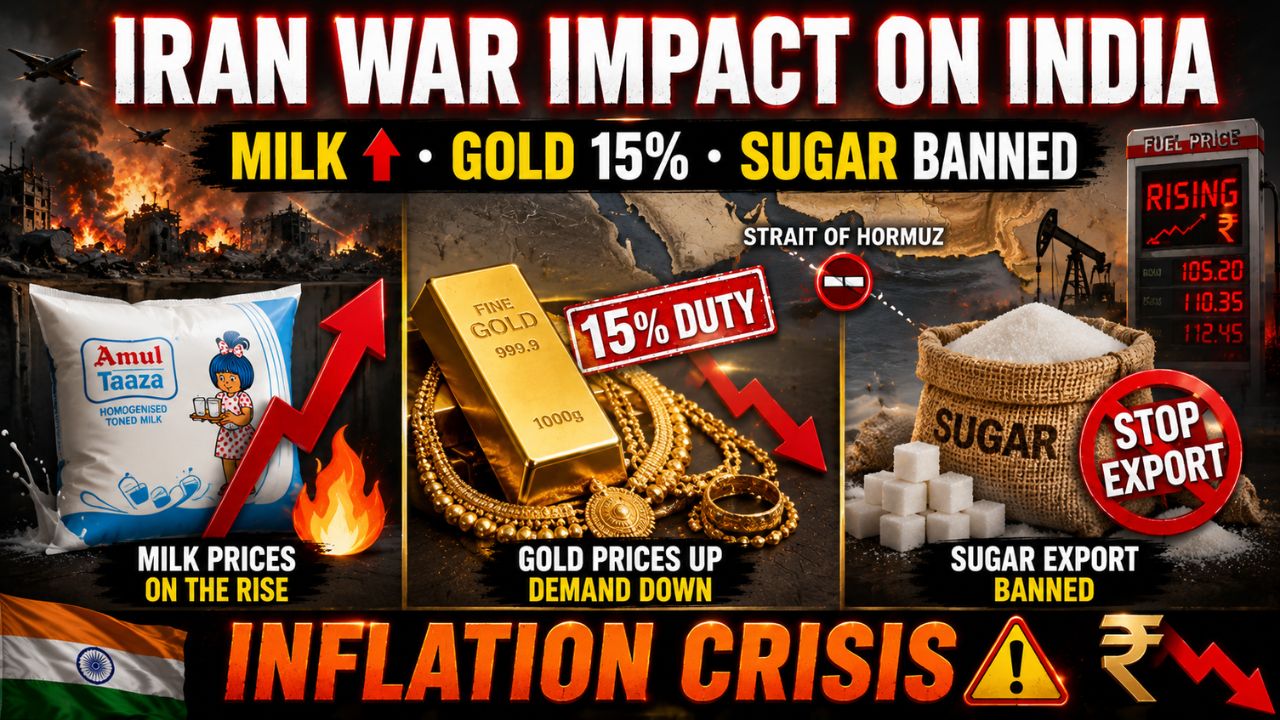
Recently, both Amul and Mother Dairy increased milk prices by ₹2 per litre after 13 months. Experts believe that products like milk, bread, and other daily-use items may continue becoming more expensive if global oil prices keep rising.

The biggest reason behind this situation is the disruption in the Strait of Hormuz, one of the world’s most important oil trade routes.

Why the Iran War Is Different

Unlike many previous conflicts, the Iran war is directly affecting global energy markets. A large amount of the world’s oil supply passes through the Strait of Hormuz. Because of blockades and rising tensions in the region, oil transportation has become risky and expensive.

This has increased fuel prices globally, which directly impacts transportation, manufacturing, and food production costs.

Milk, Gold, and Sugar Prices Rising

India is already taking several economic measures to control inflation.

Iran War

Milk Prices Increased

Amul and Mother Dairy have increased milk prices due to higher transportation and production costs caused by rising fuel prices.

Gold Import Duty Increased

The government has increased import duty on:

ItemDuty Increase
Gold15%
Silver6%

This step was taken to reduce India’s trade deficit, which means the country is importing more goods than it exports.

Prime Minister Narendra Modi has also advised citizens to reduce unnecessary gold purchases during this period.

Sugar Export Temporarily Stopped

India has also stopped sugar exports until September to prevent domestic sugar prices from rising sharply.

The government fears that increasing global demand could make sugar expensive inside India as well.

Inflation and Rupee Under Pressure

India’s wholesale inflation has reached 8.3%, mainly because of rising oil prices. Manufacturing industries and factories are facing higher raw material and transportation costs.

At the same time, the Indian rupee has weakened significantly and recently touched around ₹95.76 against the US dollar.

Experts believe that if crude oil prices rise toward $150 per barrel, the rupee could move even closer to ₹100 per dollar.

Is India Strong Enough to Handle This?

Despite these challenges, global rating agencies like S&P believe India’s economy is still relatively strong.

India currently has:

  • Strong foreign exchange reserves
  • Strategic oil reserves
  • Growing domestic demand
  • Better long-term growth potential

Although foreign investors have pulled some money out of Indian markets, experts still believe India remains one of the strongest growing economies globally.

What Can Citizens Do?

Experts believe that small actions by citizens can help reduce economic pressure.

Suggested Steps

  • Use public transport more often
  • Reduce unnecessary travel
  • Work from home when possible
  • Prefer electric vehicles
  • Reduce non-essential imports

If millions of people follow small fuel-saving habits, the overall impact can be significant.

A Major Test for the Indian Economy

The coming months may be difficult for the global economy. If the Iran war becomes more intense, inflation and oil prices may rise even further.

However, this situation is also an opportunity for India to prove the strength of its economy. If India successfully handles this crisis, global investors may gain even more confidence in the country’s economic future.

Final Thoughts

The Iran war is now affecting economies across the world. Rising fuel prices, inflation, expensive imports, and pressure on the rupee are all signs of this growing crisis.

India is facing a challenging period, but strong economic reserves and careful planning may help the country manage the situation better than many other nations. The next few months will be very important for India’s economy and its future growth.

EPFO ASO Recruitment 2026 Notification Out – Salary ₹1.75 Lakh, Eligibility, Vacancy & Exam Pattern

0
EPFO ASO

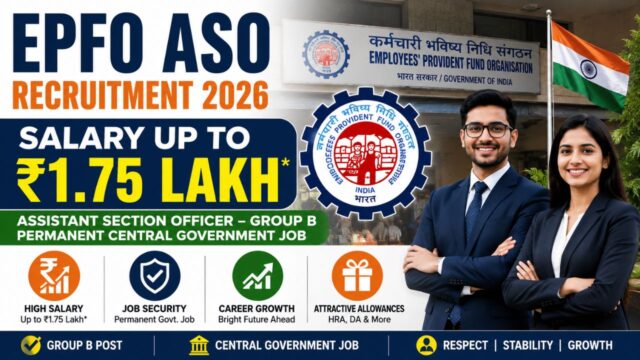
EPFO ASO Vacancy 2026 Announced

Hello everyone, welcome back to a new update. A great government job opportunity has arrived in the Employees’ Provident Fund Organisation (EPFO). The recruitment is for the post of Assistant Section Officer (ASO). This is one of the most attractive central government jobs because of its excellent salary, permanent job security, and simple selection process.

Many students believe the salary details shown online are fake, but this post actually offers a very impressive salary package. The starting in-hand salary itself is around ₹80,000 per month, and after the implementation of the 8th Pay Commission, the salary may increase up to approximately ₹1.75 lakh per month including all allowances.

In this article, we will discuss everything in simple language including salary, eligibility, age limit, exam pattern, selection process, and how to apply.

Why EPFO ASO Job Is Special

The EPFO ASO post is considered one of the best Group B government jobs in India. It is a permanent central government job with good career growth, attractive salary, and various allowances.

The organization is EPFO (Employees’ Provident Fund Organisation), which works under the Government of India.

Post Name

Assistant Section Officer (ASO)

Category

Non-Gazetted Group B Post

Job Type

Permanent Central Government Job

Exam Conducting Authority

IBPS conducts the examination process for this recruitment.

EPFO ASO Salary Structure 2026

The biggest attraction of this job is its salary package. Compared to many railway and other government exams, the EPFO ASO salary is considered much higher.

Initial In-Hand Salary

The starting in-hand salary is approximately:

  • ₹80,000 per month

This post comes under Pay Level 7.

Salary After 8th Pay Commission

After the implementation of the 8th Pay Commission, the expected salary may become:

  • Around ₹1,75,000 per month

This amount includes several allowances such as:

  • Dearness Allowance (DA)
  • House Rent Allowance (HRA)
  • Travel Allowance (TA)
  • Fixed Medical Allowance (FMA)

The government is expected to implement the 8th Pay Commission in the future, which can significantly increase the salary.

Even currently, ₹80,000 per month is considered an excellent starting salary for fresh graduates.

Who Can Apply For EPFO ASO Recruitment?

The eligibility criteria for this recruitment are very simple.

Educational Qualification

Candidates only need:

  • Graduation in any stream from a recognized university

Students from any subject or field can apply.

Experience Requirement

  • No prior work experience is needed.
  • Freshers can directly apply.

This makes the vacancy suitable for a large number of graduates across India.

Age Limit For EPFO ASO 2026

The minimum and maximum age criteria are as follows:

  • Minimum Age: 20 years
  • Maximum Age: 27 years

However, age relaxation is provided according to government rules.

Category-Wise Age Relaxation

CategoryMaximum Age
General (UR)27 Years
OBC30 Years
SC/ST32 Years

This means candidates between 20 and 32 years can apply depending on their category.

EPFO ASO Selection Process

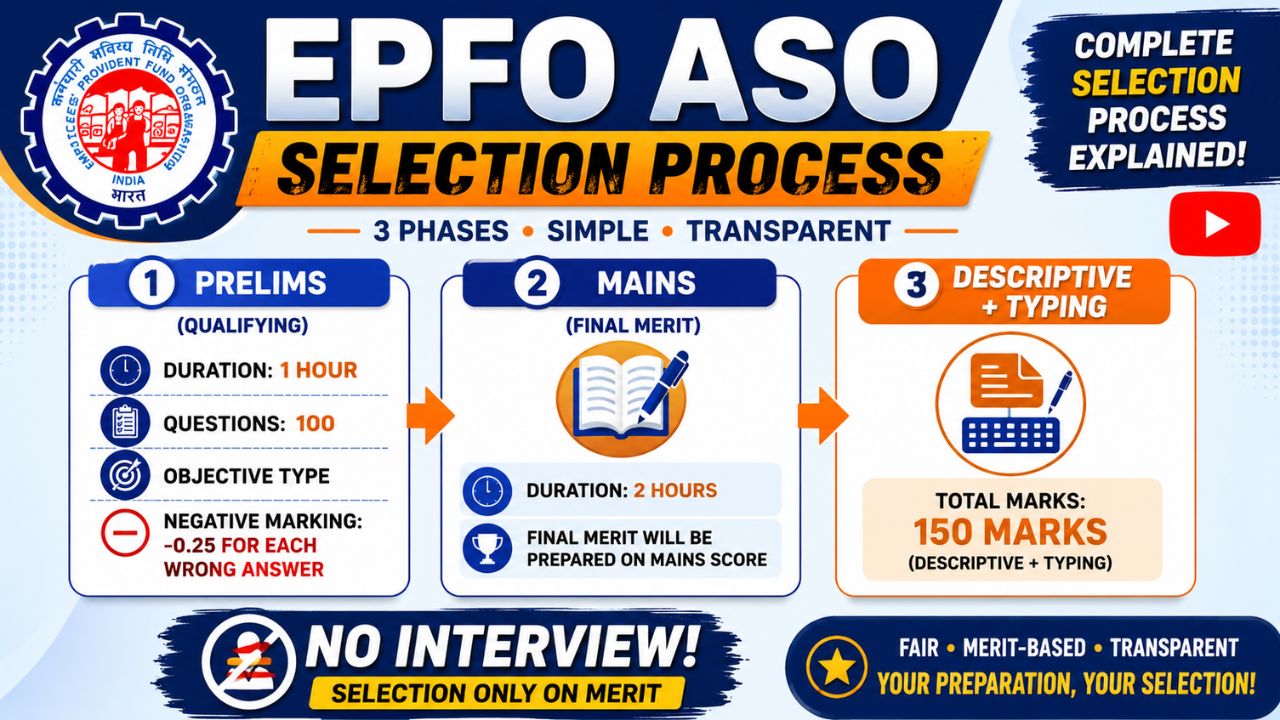
The selection process has three stages.

Phase 1 – Preliminary Examination

This is also called:

  • Tier 1
  • CBT 1

This exam is only qualifying in nature. Marks from this stage are not added to the final merit.

EPFO ASO

Subjects In Prelims

SubjectQuestionsTime
English3020 Minutes
Reasoning3520 Minutes
Mathematics3520 Minutes

Total

  • 100 Questions
  • Total Time: 1 Hour

Negative Marking

There is negative marking of:

  • 0.25 marks for every wrong answer

Candidates only need to clear the cutoff to move to the next stage.

Phase 2 – Main Examination

This is the most important stage because final selection mainly depends on Phase 2 and Phase 3 performance.

Subjects In Mains

SubjectQuestionsMarks
Reasoning4060
General Awareness, Economics & Finance4040
English3040
Mathematics4060

Total Duration

  • 2 Hours

The cutoff and merit list are mainly based on this exam.

Phase 3 – Descriptive & Typing Test

The third stage checks writing skills and typing ability.

What Happens In This Round?

Candidates may be asked to:

  • Write essays
  • Draft letters
  • Complete descriptive writing tasks
  • Take typing tests online

Total Marks

  • 150 Marks

This phase is also important for final selection.

No Interview In EPFO ASO

One of the best things about this recruitment is that:

  • There is no interview.

Selection is completely based on exams and typing/descriptive performance. This reduces pressure for many students.

How To Apply For EPFO ASO Recruitment 2026

Candidates can apply online through the official EPFO or IBPS website.

Application Steps

  1. Visit the official website.
  2. Complete online registration.
  3. Fill the application form carefully.
  4. Upload documents and photographs.
  5. Pay the application fee.
  6. Submit the form online.

Students can also search on YouTube:

  • “EPFO New Vacancy 2026 Form Apply”

Many tutorial videos are available explaining the application process step by step.

Preparation Tips For EPFO ASO Exam

Competition for this vacancy is expected to be very high because of the attractive salary and permanent government job benefits.

Start Preparation Early

Do not wait for the official detailed notification. Start your preparation now.

Important Subjects To Focus On

  • English
  • Reasoning
  • Quantitative Aptitude
  • General Awareness
  • Finance & Economics Basics

Regular mock tests and typing practice can greatly improve your chances.

Final Words

EPFO ASO Recruitment 2026 is one of the best opportunities for graduates looking for a stable and high-paying central government job. With a starting salary of around ₹80,000 per month, no interview, and eligibility for freshers, this vacancy is attracting huge attention across India.

Candidates from any stream can apply, and the selection process is completely exam-based. If you prepare seriously and consistently, this can become a life-changing opportunity.

Do not miss this chance. Start your preparation today and apply as soon as the application window opens.

- Advertisement -
Google search engine

APPLICATIONS

HOT NEWS

8th Pay Commission 2026: Expected Salary Hike for SSC, Railway &...

0
Big Update for Government Job Aspirants Currently, the 8th Central Pay Commission (8th CPC) has become one of the most important discussion topics among students...