

Introduction
After winning the elections and forming a strong government, India is now focusing on another major challenge – the economy. The ongoing conflict in the Middle East has become a serious concern for India’s energy security and foreign exchange reserves. To address this problem, PM Modi has urged citizens to reduce unnecessary fuel use, avoid foreign trips, work from home if possible, and delay luxury spending such as gold purchases.
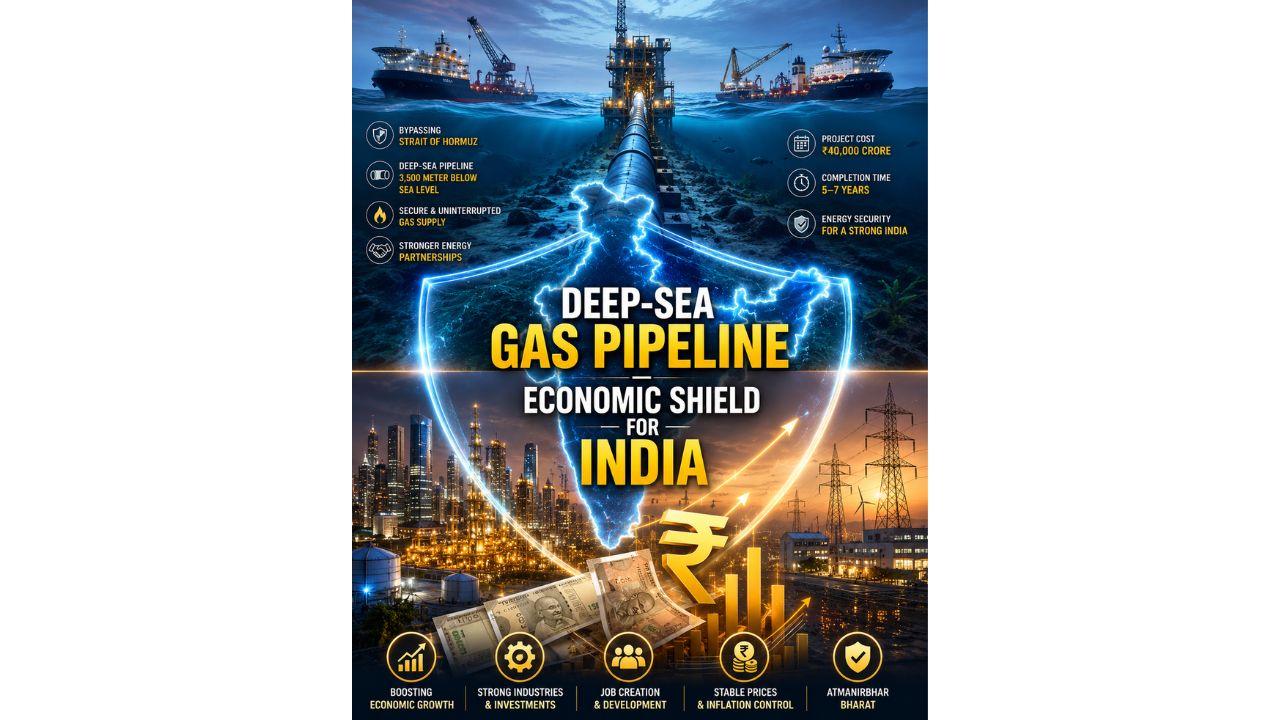
At the same time, the government of India is planning a massive new project worth around ₹40,000 crore which is going to be a deep-sea gas pipeline from Oman to India. If successful, this project could reduce India’s dependence on the Strait of Hormuz and improve long-term energy security.
Why India Is Worried About Energy Security
India imports nearly 90% of its oil and gas needs from foreign countries. Most of these supplies come through the Strait of Hormuz, a narrow sea route in the Middle East. Countries like UAE, Qatar, Saudi Arabia, and Iran use this route to send oil and gas to India.
The problem is that the current Middle East conflict has made this region unstable. Shipping risks have increased, insurance costs are rising, and there is always fear that supply routes may get blocked. If that happens, India could face shortages of LPG, crude oil, and natural gas.
This is why the Indian government is now trying to find safer and more stable alternatives.
The ₹40,000 Crore Deep-Sea Gas Pipeline Project
According to reports, India is considering building a deep-sea gas pipeline from Oman directly to the Indian coast, possibly Gujarat or Maharashtra. The project may take around 5 to 7 years to complete and is expected to cost nearly ₹40,000 crore. The Ministry of Petroleum has reportedly asked government-linked companies such as GAIL, Engineers India Limited, and IOCL to prepare a detailed feasibility report for the project.
How Will the Pipeline Work?
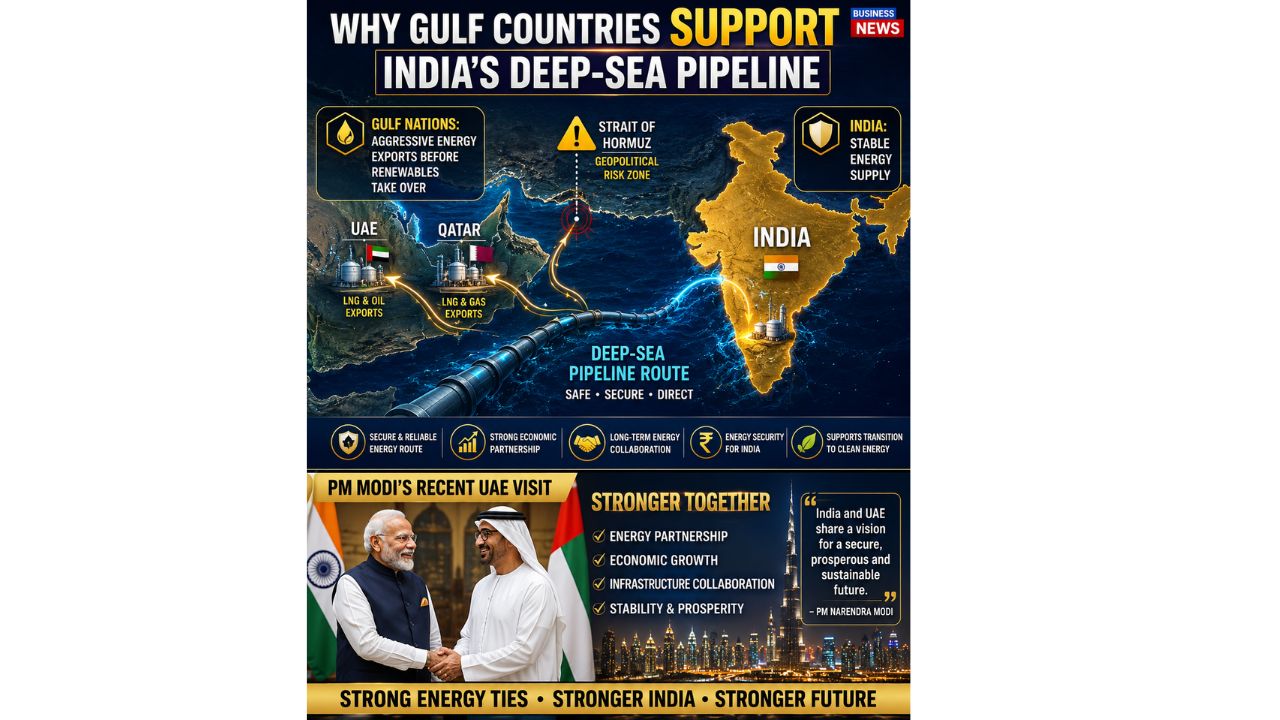
Currently, most oil and gas shipments travel through the Strait of Hormuz. Under the new plan, a pipeline will be laid deep under the Arabian Sea, bypassing this risky route completely.
The pipeline would start from Oman and connect directly to India. Other Gulf countries such as Qatar, UAE, and even Saudi Arabia could send gas to Oman first, and then Oman could transfer it to India through this pipeline.
This would reduce India’s dependence on unstable sea routes and ensure uninterrupted gas supply even during geopolitical tensions.
One of the Deepest Sea Gas Pipelines in the World
Reports suggest that the pipeline could be laid nearly 3,500 meters below sea level. If completed, it may become one of the deepest undersea gas pipelines in the world.
Earlier, such projects were considered too expensive and technically difficult. But modern deep-sea pipeline technology has reduced construction costs significantly.
South Asian Gas Enterprise (SAGE), an Indian company, has already tested pipeline technology at depths of around 3,000 meters. This has increased confidence that the project is technically possible.
Why Gulf Countries Also Support This Idea
Countries like UAE and Qatar are also looking for new energy export opportunities. Many experts believe that Gulf nations now want to sell their oil and gas more aggressively before the world shifts heavily toward renewable energy.
At the same time, dependence on the Strait of Hormuz creates uncertainty for them as well.
Because of this, a direct deep-sea pipeline to India could benefit both sides:
- India gets stable energy supplies.
- Gulf countries get a secure and long-term export route.
This is one reason why Prime Minister Modi’s recent visit to UAE is being seen as strategically important.
India Had This Idea Earlier Too
Interestingly, this is not the first time India has discussed such a project.
Back in 2015, a proposal for a deep-sea gas pipeline was already suggested. The idea was to bypass Pakistan and avoid geopolitical risks connected with land-based pipelines such as:
- TAPI Pipeline (Turkmenistan-Afghanistan-Pakistan-India)
- IPI Pipeline (Iran-Pakistan-India)
However, despite discussions, the proposal did not move forward at that time.
Many experts now believe that India often reacts only after a crisis becomes serious instead of planning in advance.
Coal Gasification: Another Big Energy Move
Apart from the deep-sea pipeline, the Indian government has also approved a massive ₹37,500 crore coal gasification scheme.
In this process, coal is converted into synthetic gas, which can later be used like natural gas.
India has large coal reserves, so this technology could help reduce gas imports in the future.
However, critics point out that India announced coal gasification targets years ago, but progress has been very slow.
The Russia Factor
Russia has also assured India that energy cooperation between the two countries will continue despite global tensions.
In recent years, India reduced some Russian oil purchases under international pressure. As a result, India reportedly lost some discounted oil benefits that Russia had earlier provided.
Many analysts believe India should maintain strong energy partnerships with multiple countries to protect itself during global crises.
India’s Biggest Challenge: Energy Dependence
The biggest concern is that India still depends heavily on imported energy.
Even though renewable energy capacity is increasing rapidly, India still faces major storage problems. Solar energy is produced during the day, but without proper battery storage systems, much of it cannot be fully used at night.
This means India still relies heavily on fossil fuel imports.
Experts believe India needs a long-term national strategy to reduce energy import dependence step by step over the next 10–20 years.
Conclusion
The proposed Oman-India deep-sea gas pipeline could become one of India’s most important strategic energy projects. If implemented successfully, it may help India reduce risks from Middle East conflicts, stabilize gas supplies, and strengthen energy security.
At the same time, the project also shows how global wars and geopolitical tensions can directly affect ordinary people through rising fuel prices, inflation, and economic uncertainty.
India now faces a major challenge: balancing economic growth while reducing dependence on imported energy. Whether through deep-sea pipelines, renewable energy, or coal gasification, the country is clearly preparing for a future where energy security will become more important than ever.