
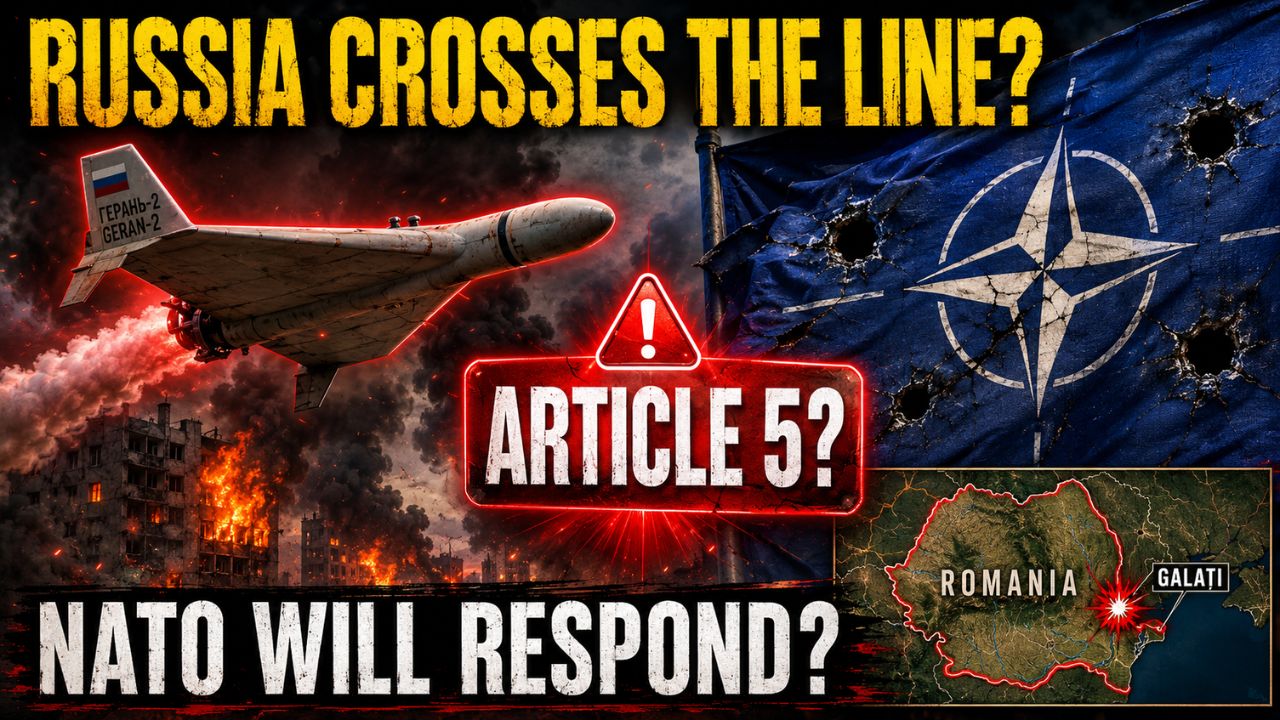
A new controversy has emerged in the ongoing Russia–Ukraine war after a Russian drone reportedly struck inside NATO member country Romania. The incident has raised serious questions about whether NATO could invoke Article 5, the alliance’s collective defense clause.
Romanian officials confirmed that a Russian drone crossed the border and exploded near a residential building, injuring two civilians. Although some officials described the incident as an “accident,” many experts believe the timing of the strike may have been a deliberate message from Russia to both Europe and NATO.
Russian Drone Hits Romanian Territory
According to reports, a Russian “Geran-2” drone — the Russian version of the Iranian Shahed drone — crossed nearly 10 kilometers into Romanian territory before hitting a building near the Ukraine border. The strike reportedly took place near the Romanian city of Galați, close to Ukraine’s important Izmail port area on the Danube River. Russia was carrying out drone attacks on Ukrainian infrastructure in the region when one of the drones entered Romanian airspace.
Two civilians were injured in the explosion, making this one of the most serious incidents involving a NATO country since the Russia–Ukraine war began. Romania strongly criticized the attack and called it an irresponsible action that could lead to escalation. The Romanian government also requested stronger anti-drone defense systems from NATO allies.
Why the Timing of the Attack Is Important
The timing of the incident has become a major talking point internationally. The drone strike happened on the same day as two important developments related to Ukraine and Europe.
1. European Union Approved Massive Loan Package for Ukraine
Ukraine’s parliament officially approved a €90 billion European Union loan package. The financial support will be distributed over two years:
- €45 billion in 2026
- €45 billion in 2027
This funding is expected to provide Ukraine with long-term and predictable military support rather than temporary aid packages. Ukraine has announced that a major portion of this money will be used for defense spending, which could push the country’s military budget above €100 billion this year — even higher than India’s defense budget.
2. Ukraine Finalized Gripen Fighter Jet Deal
At the same time, Ukrainian President Volodymyr Zelenskyy visited Sweden to strengthen defense cooperation. Ukraine is expected to:
- Receive 16 donated Gripen fighter jets from Sweden
- Purchase 20 new Gripen E/F fighter aircraft
- Potentially acquire 100–150 Gripen jets in the long term
These fighter jets are considered highly advanced and could significantly challenge Russian air operations.
Important Events at a Glance
| Topic | Important Details |
|---|---|
| Drone Incident | Russian drone hit Romanian territory near Galați |
| Casualties | 2 civilians injured |
| NATO Response | Romania requested stronger anti-drone systems |
| EU Support to Ukraine | €90 billion loan package approved |
| Funding Timeline | €45B in 2026 and €45B in 2027 |
| Ukraine Defense Budget | Expected to cross €100 billion |
| Sweden–Ukraine Deal | 16 donated Gripen jets + 20 new purchases |
| Main Concern for Russia | Stronger Ukrainian air power |
Why Gripen Fighter Jets Matter
The Swedish Gripen fighter jets could create major operational problems for Russia.
These aircraft are:
- Multi-role combat fighters
- Capable of rapid deployment
- Able to operate from short runways
- Equipped with advanced electronic warfare systems
Most importantly, they can carry Meteor air-to-air missiles, which have:
- Operational range up to 120–200 km
- “No-escape zone” of nearly 60 km
This could make it difficult for Russian aircraft like the Sukhoi Su-34 to launch glide bombs safely over Ukrainian territory. Currently, Russia heavily relies on glide bombs because they cause massive destruction while allowing aircraft to stay relatively far from targets. However, the Gripen–Meteor combination may force Russian jets to operate more cautiously.
Was the Drone Strike a Message From Russia?
Many analysts believe the drone strike may not have been a simple mistake. Ukraine and several Western observers argue that the timing suggests strategic signaling by Russia. The message could be aimed at:
- NATO countries
- The European Union
- Nations increasing military aid to Ukraine
However, some experts also point out that Shahed/Geran drones are known to face navigation issues, especially at low altitudes near borders. Because the strike occurred only 10 km inside Romania, there is still debate over whether it was intentional or accidental.
Why NATO Is Avoiding Article 5
Even after the incident, NATO has not discussed invoking Article 5 seriously. Article 5 states that an attack on one NATO member is considered an attack on all members. If activated, it could potentially lead to direct military conflict between NATO and Russia. However, NATO countries appear cautious for several reasons:
Fear of Direct War With Russia
NATO is currently supporting Ukraine heavily with:
- Weapons
- Intelligence
- Financial assistance
- Training
But NATO leaders do not want a full-scale conventional war directly against Russia.
Nuclear Escalation Risk
Russia has repeatedly warned that direct NATO involvement could lead to nuclear escalation. Russian military doctrine includes the idea of “escalate to de-escalate,” where limited tactical nuclear weapons could be used to force opponents to back down during a major conflict. This risk makes NATO extremely careful about crossing certain red lines.
NATO vs Russia: Current Reality
| Situation | Current Position |
|---|---|
| NATO Support for Ukraine | Strong military and financial backing |
| Direct NATO War | NATO wants to avoid it |
| Article 5 Invocation | Not likely at present |
| Russia’s Strategy | Pressure Europe without full NATO war |
| Europe’s Strategy | Strengthen Ukraine while avoiding nuclear escalation |
Europe Wants Ukraine Strong — But No Direct NATO War
Western countries appear comfortable continuing a proxy-style conflict where Ukraine fights Russia with Western support. Their strategy is:
- Keep Ukraine militarily strong
- Avoid direct NATO troop involvement
- Stay below the nuclear escalation threshold
This approach allows Europe and NATO to pressure Russia without risking a world war. At the same time, Russia seems determined to show that continued European support for Ukraine could also bring risks to NATO countries themselves.
Conclusion
The Romanian drone strike has added a new layer of tension to the Russia–Ukraine conflict. While Romania called for stronger protection, NATO is clearly trying to avoid direct confrontation with Russia. At the center of the issue is a delicate balance:
- Europe wants to continue supporting Ukraine
- Russia wants to discourage deeper Western involvement
- NATO wants to avoid nuclear escalation
As Ukraine receives more advanced weapons and long-term European funding, incidents like this may become more frequent — increasing the risk of further escalation across Europe.