

India is currently one of the fastest-growing major economies in the world. After the economic reforms of 1991, the private sector became one of the biggest drivers of India’s growth. Many Indian companies expanded globally, created jobs, and helped India build a strong position in technology, services, and manufacturing.
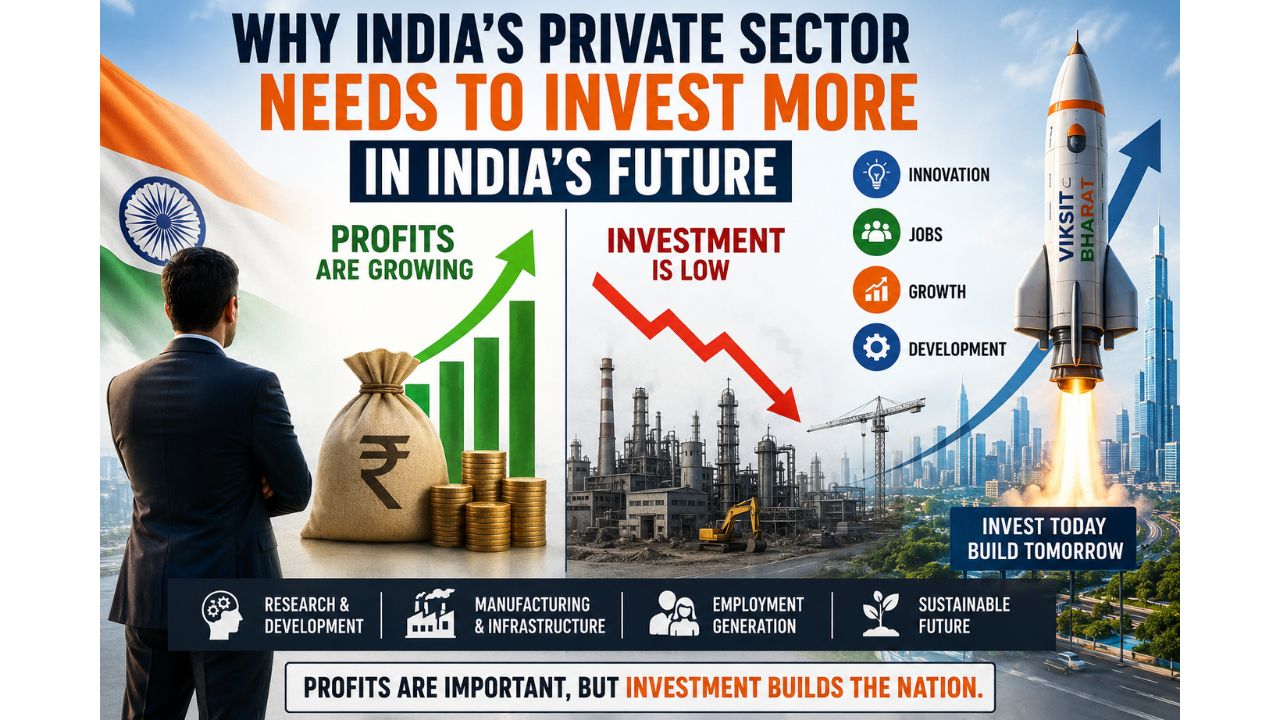
However, a recent statement by India’s Chief Economic Advisor (CEA), V. Anantha Nageswaran, has started an important discussion about the role of the private sector in India’s future development. According to him, many large Indian companies are earning record profits, but they are not investing enough money back into the Indian economy.
This has become a serious concern because India wants to become a “Viksit Bharat” or a developed nation in the coming years.
Record Profits but Low Investment
The Chief Economic Advisor said that India’s top 500 companies have seen their profits grow by around 30% annually after the COVID-19 period. This shows that many businesses are financially strong and earning huge amounts of money.
But the important question is that: Are these profits helping India grow in the long term?
According to the government’s data and Economic Survey reports, the answer is not very encouraging. While companies are making profits, they are not spending enough on new factories, research, innovation, technology, or infrastructure inside India.
Instead of increasing investment, many companies are simply saving money, investing abroad, paying dividends to shareholders, or keeping funds in financial assets.
Why Capital Investment Matters
Capital investment, also known as capital expenditure or “capex,” is extremely important for economic growth. When companies invest in factories, machines, technology, research, and infrastructure, it creates jobs, improves productivity, and increases future growth.
At present, most of India’s large investment projects are being driven by the government rather than the private sector. The government is spending heavily on roads, railways, airports, and infrastructure, but private companies still appear hesitant to invest aggressively.
This is one of the biggest structural problems facing the Indian economy today.
Tax Cuts Did Not Increase Investment
In 2019, the Indian government reduced corporate tax rates from 30% to 22% to encourage private companies to invest more in India.
The expectation was simple:
Lower taxes would leave companies with more money, and that extra money would be used to expand businesses and create new opportunities.
However, according to the Chief Economic Advisor, this has not happened at the expected level. Many companies used the extra profits to reduce debt, invest overseas, or increase returns for shareholders instead of investing in India’s productive sectors.
This has raised concerns about whether Indian corporations are contributing enough toward nation-building.
Lack of Innovation in India
Another major issue highlighted is the low spending on research and development (R&D).
India spends only around 0.6% of its GDP on R&D, which is much lower than countries like the United States, China, and Israel. Even more concerning is that most of India’s R&D spending comes from the government rather than private companies.
This lack of innovation can become a major challenge in the future. Today, the global economy is rapidly changing due to technologies like:
- Artificial Intelligence (AI)
- Robotics
- Biotechnology
- 3D Printing
- Advanced Manufacturing
- Clean Energy
Countries that invest heavily in innovation are leading the world economy. India also has talented engineers, scientists, and entrepreneurs, but many Indian companies still avoid taking risks in advanced technologies.
For example, India still does not have a globally dominant AI platform comparable to some international models. Critics argue that many Indian companies focused more on short-term profits instead of building future technologies.
Financialization of the Economy
The Chief Economic Advisor also warned about the growing “financialization” of companies.
This means companies are becoming more focused on stock market performance, shareholder returns, and financial gains rather than real economic growth.
Today, success is often measured by:
- Rising share prices
- High dividends
- Quarterly profits
As a result, many companies prefer financial gains over long-term investments in factories, innovation, or manufacturing expansion.
This trend may increase profits in the short term, but it does not always help create sustainable economic growth.
India’s Consumption Problem
India is often called a consumption-based economy because millions of people buy goods and services every day. However, experts believe this consumption growth is unequal.
Wealthier people continue spending more money, but many middle-class families, gig workers, and informal workers still face financial pressure.
If income inequality increases and investment remains weak, economic growth may slow down in the future.
That is why India needs both strong consumption and strong investment to maintain long-term growth.
The Need for Responsible Capitalism
The article also highlights an important idea: businesses should not focus only on profit. Companies should also think about people, purpose, and the planet.
This approach is becoming increasingly important worldwide. Successful businesses of the future will likely be those that:
- Create jobs
- Invest in innovation
- Support sustainable development
- Help society grow
- Protect the environment
Profit is important for every company, but profits should also contribute toward national development.
Conclusion
India has huge potential to become a developed nation in the coming decades. The country has a large population, talented youth, growing markets, and improving infrastructure.
However, for India to truly achieve the dream of “Viksit Bharat,” the private sector must play a bigger role in long-term investment, innovation, and nation-building.
The government alone cannot drive economic growth forever. Private companies must also invest in technology, research, manufacturing, and future industries inside India.
The recent remarks by the Chief Economic Advisor are an important reminder that profits alone are not enough. Sustainable growth comes when businesses invest in the future of the country along with their own success.