

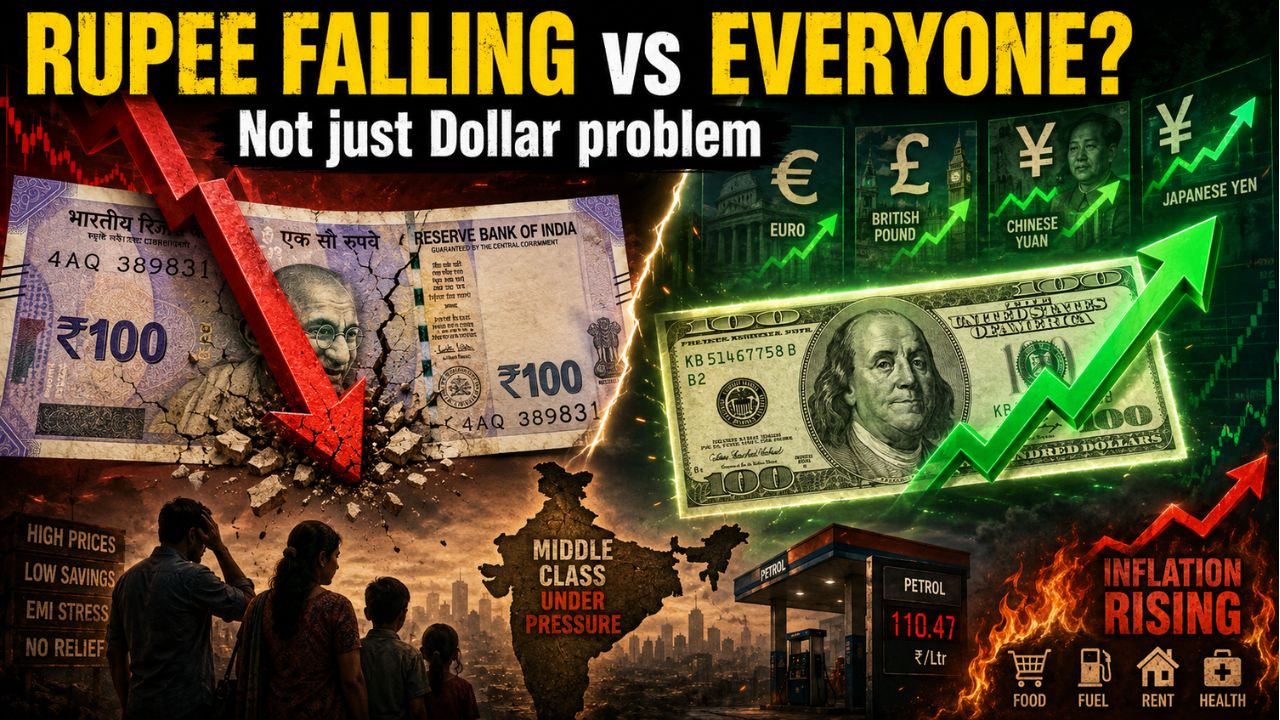
Whenever the Indian Rupee falls against the US Dollar, headlines start appearing everywhere. At such times, many people remember a famous statement made by India’s Finance Minister: “The Rupee is not weakening, the Dollar is strengthening.” This statement is often used to explain the fall of the Rupee. The idea is that the problem is not with India, but with the increasing strength of the US Dollar.
But what if the reality is much bigger than that? What if the Indian Rupee is not only falling against the Dollar, but also against almost every major currency in the world? This raises a serious question: Is this only America’s story, or is there a deeper structural problem inside the Indian economy? Let us understand the complete picture in simple language.
Why Does a Falling Rupee Matter?
To understand this, imagine a simple example.
Earlier:
1 US Dollar = ₹80
Now:
1 US Dollar = ₹95
Technically, India’s GDP may still be growing. But practically, ordinary people become poorer. Why? Because India is heavily dependent on imports.
India imports:
- Crude oil
- Electronic chips
- Machinery
- Weapons
- Solar panels
- Technology products
Most of these items are purchased using Dollars. So when the Rupee weakens, all imported products become more expensive. This directly increases inflation and affects the daily lives of common people.
The Rupee Is Falling Against Many Currencies
The situation becomes more serious because the Rupee is not weakening only against the Dollar. It has also weakened against:
- Euro
- British Pound
- Chinese Yuan
- Japanese Yen
- UAE Dirham
- Singapore Dollar
In many cases, the Rupee has fallen by 15% to 25% against these currencies over the past year. This completely challenges the argument that only the US Dollar is becoming stronger. If the Rupee is falling against almost every major currency, then the problem is much deeper.
Main Reasons Behind the Falling Rupee
1. India’s Trade Deficit
India imports more goods than it exports. India earns foreign currency by exporting:
- Software services
- IT solutions
- Some manufactured products
But India spends huge amounts on importing:
- Oil
- Gold
- Electronics
- Machinery
- High-end technology
As a result, more Dollars leave India than enter India. When demand for Dollars increases and supply decreases, the Rupee naturally weakens.
2. Oil Dependency and Global Tensions
India imports nearly 80–85% of its crude oil needs.
At the same time, geopolitical tensions are increasing globally.
Some major global tensions include:
- Middle East conflicts
- Red Sea shipping disruptions
- China-Taiwan tensions
- Rising energy prices
Because of these problems, oil prices rise globally. When India buys more expensive oil from abroad, the pressure on the Rupee increases further.
3. US Federal Reserve Policies
Whenever the US Federal Reserve increases interest rates, global investors prefer investing in America. Why? Because US bonds provide:
- Safer returns
- Stable investment
- Higher interest rates
As a result, foreign investors withdraw money from countries like India and invest in the US. This is called: Capital Outflow, When billions of Dollars leave Indian markets, the Rupee weakens sharply.
GDP Growth Does Not Always Mean Currency Strength
Many people ask: “If India’s economy is growing at 7–8%, then why is the Rupee weak?” This is an important question. Economic growth and currency strength do not always move together.

If growth is mainly based on:
- Consumption
- Imports
- Spending
instead of manufacturing and exports, then the currency may still remain weak. India is currently one of the world’s largest consumer markets. We consume massive amounts of products, but many of the important components still come from abroad.
For example:
- Mobile chips are imported
- EV battery materials are imported
- High-end electronics are imported
This creates structural weakness in the economy.
Lessons from China, Germany, and Japan
- Countries with strong currencies usually have strong manufacturing systems is China. China became the “factory of the world” through manufacturing exports.
2. Germany :- Germany strengthened its economy by exporting machinery and industrial products.
3. Japan:- Japan built global power through automobiles and electronics.
These countries created export-led growth models. India, however, still depends heavily on consumption and imports. That is why long-term currency strength remains a challenge.
Are Pakistan and Bangladesh Performing Better?
This topic has become very popular on social media. Some people claim that Pakistan and Bangladesh are performing better than India because their currencies are falling more slowly. But this comparison is misleading.
1. Pakistan:- Pakistan’s economy is currently surviving mainly through IMF loans and external support.
2. Bangladesh:- Bangladesh is also facing debt pressure and political instability.
However, some data shows that the pace of depreciation in their currencies was slower than the Indian Rupee during certain periods. This does not mean their economies are stronger than India. But it does create concern because India claims to become:
- A 5 trillion dollar economy
- A global economic power
Naturally, expectations from India are much higher.
The Biggest Impact on the Indian Middle Class
The real crisis is not only about exchange rates. The real crisis is the silent financial pressure on India’s middle class. When the Rupee falls:
- Foreign education becomes expensive
- International travel becomes costly
- Imported gadgets become expensive
- Petrol and diesel prices increase
- Transportation costs rise
- Food inflation increases
Even if salaries remain the same, purchasing power decreases. People slowly start feeling financially weaker.
What Can RBI Do?
The Reserve Bank of India (RBI) has some traditional tools to control currency weakness. These include:
1. Selling Dollars
RBI can sell foreign reserves to support the Rupee.
2. Changing Interest Rates
Higher interest rates can attract investors.
3. Market Regulation
RBI can intervene in currency markets. However, these are temporary solutions. The deeper structural problems still remain.
Long-Term Solutions for India
If India truly wants a stronger Rupee, then long-term reforms are necessary.
1. Boost Manufacturing
India must increase domestic production. “Make in India” should become stronger at the ground level.
2. Increase Exports
Indian products must become globally competitive. The world should buy more Indian goods and technology.
3. Reduce Oil Dependency
India must shift faster toward:
- Green hydrogen
- Renewable energy
- Ethanol
- Electric mobility
Reducing oil imports will reduce pressure on the Rupee.
4. Build Real Economic Capacity
Economic slogans alone are not enough. India needs:
- Strong industries
- Innovation
- Technology leadership
- Export power
Currency Is Also a Strategic Weapon
In today’s world, currencies are not just pieces of paper. Currencies represent:
- Economic trust
- Global respect
- Strategic power
The US uses Dollar dominance as global influence. China uses Yuan diplomacy to expand its reach. BRICS countries are discussing de-dollarization strategies. If India wants to become a major global power, then a strong and stable currency becomes extremely important.
Final Thoughts
The falling Rupee is not just about the Dollar becoming stronger. It reflects deeper challenges inside India’s economy, including:
- Import dependency
- Weak manufacturing
- High oil imports
- Global investment risks
India still has huge potential because of:
- Its large market
- Young population
- Growing economy
- Expanding infrastructure
But long-term economic strength will only come when India focuses more on production, exports, and self-reliance. The real question is not: “How much has the Rupee fallen?”. The real question is: “Can India build an economy strong enough to support a powerful and respected currency in the future?”